Followers

Tuesday, May 7, 2019

Won't You Be My Neighbor? (2018)

Directed by Morgan Neville; produced by Morgan Neville, Nicholas Ma and Caryn Capotosto


This is a documentary about a unique person in television, and in children’s education. Fred Rogers not only was the host of the tv series Mr Rogers’ Neighborhood, from 1968 until 2001, but was its producer, music arranger, puppeteer and writer. Thirty-three years of holding those positions would qualify for a documentary on their own, but having the effect on children - and adults - that Rogers did, makes their analysis almost necessary.

Won’t You Be My Neighbor? doesn’t quite follow the usual format of a filmed documentary. It is not completely linear because, while it does start by examining the early days of Fred Rogers’s involvement with television, and ends with his death in 2003, it moves back and forth in time, depending on the aspect of Rogers’s life and career it is examining. It comprises archival footage, interviews, even animation; like its subject, it is not exciting, but it is entertaining, interesting, intriguing, and never dull.


The picture the movie paints of Fred Rogers is an overwhelmingly complimentary one - indeed, from other stories and discussions of the man, it seems that it would have been difficult to construct a derogatory documentary - but it doesn’t let him off the hook entirely. His two sons imply that it was not easy being Mr Rogers’s offspring, though it is equally implied that this was not Rogers’s fault. As well, he appears to have been a very determined man, which could be frustrating, even annoying, for more laid-back people, but his determination was in the best causes.


The documentary is a good one in that it considers not just Rogers, nor his attempts to educate children, but how he did it. His unflinching tackling of topics such as divorce and racism, death and even political assassination, is probably unparalleled in children’s television. What made him superior to many programmes that attempted the same was that he dealt largely in children’s feelings; how a child reacts to certain events or influences, and why negative reactions are not always bad.


There are very affecting moments in the film, such as when Rogers appeared before a U.S. congressional committee to help obtain funding for public television. Facing a politician notorious for his antagonism to tv, Rogers convinced the man to support public television in a matter of minutes. (This scene is notable not just for Rogers’s earnestness and success but for its demonstration that there was a time when politicians could be persuaded of new ideas, and did not rigidly adhere to the party line to the exclusion of all good. Yes, it was a long time ago.) Also moving, in another way, is Rogers’s interaction with the famous gorilla Koko. She did not know Rogers’s as a tv personality but quickly created a bond with him. (This says perhaps just as much about Koko as Rogers.)


One of the most intriguing moments for me was when it described how quiet, even silent, Rogers’s instruction could be. In one scene, he demonstrated the length of a minute, using a timer - and silence. This reminded me of something many children’s educators and entertainers have forgotten - if they ever knew it. Children often play and learn quietly, even noiselessly. Anyone who has watched children, especially a single child, at play, will note this. That is often when learning is most effective. If a documentary can give a viewer a revelation, there is something to it.

But Won’t You Be My Neighbor? is more than just a few good moments. It is a telling and affectionate tribute to an unprecedented phenomenon in television, probably one not to be repeated. And the fact that the world thinks there is no room for another Mr Rogers, that it has moved beyond him, is, unfortunately, its saddest statement.

Tuesday, April 30, 2019

The Spider and the Fly (1949)

Directed by Robert Hamer; produced by Aubrey Baring


A daring bank robbery late at night in 1913 France has the government outraged, but Fernand Maubert (Eric Portman), director of the detective police, knows who is responsible: master-thief Philippe Lodocq (Guy Rolfe). The two men have battled each other previously, Lodocq sometimes getting away with his crimes, Maubert sometimes putting him in prison. Maintaining their respect for each other, as well as a polite kind of contempt, they find a new bond - and rivalry - in Lodocq’s new accomplice, the beautiful Madeleine Saincaize (Nadia Gray). And on the eve of the Great War, the two men may find their latest encounter their last.


A well-written drama, The Spider and the Fly is part crime thriller and part character study. The game the two leads play against each other is serious and multi-faceted. The lines each speaks to the other are often on at least two planes at once as they try to intimidate each other, and search for each other’s weaknesses. Yet at the same time, they are quite honest with each other - in their own fashion. One feels that Maubert genuinely thinks that Lodocq’s life of crime is a waste of a good man, a gentleman, who should have aspired to something better, while Lodocq scoffs at Maubert’s plodding, almost parochial life.


The acting is very good, particularly by the two leads. Their solemnity may seem incongruous compared to some of the comic relief thrown in from time to time (comic actor Arthur Lowe beginning his career as a town clerk; Sebastian Cabot (Mr French of tv’s A Family Affair) as a provincial policeman) but I think this reflects the seriousness with which they live their lives. Maubert is shown unbending in several brief scenes - when he has reason to.


The story has several levels, too, like the characters. Seemingly a cops-and-robbers story, it involves romance and personality, politics and warfare. It’s the sort of movie that could have made a tv series, as long as the original writer (in this case, Robert Westerby) stayed throughout its run. As well, the romantic elements don’t go where one might expect, and the conclusion is an ironic twist. As for the love-triangle, viewers will very likely not guess with whom Gray ends up leaving at the end.


The Spider and the Fly is not a classic but is very good, with solid writing, acting and directing. The setting in France lends an air not found in British or American settings and the writer knows how to incorporate small touches to make the Gallic location add to the film, while the players know how to display those touches. All in all, this is a movie that deserves to be remembered more than it has been.

Monday, April 22, 2019

The Man Who Cheated Himself (1950)

Directed by Felix E. Feist; produced by Jack M. Warner


A woman (Jane Wyatt), fearful that her husband (Harlan Warde) is planning to kill her, frantically calls her lover, a veteran police detective (Lee J Cobb). He arrives at Wyatt’s house just as the husband returns to implement his plan. In a panic, Wyatt shoots her spouse dead. Thinking that a cover-up would be less dangerous than the truth, Cobb dumps the body at the airport, and, being the leading investigator, hopes to make the death seem a violent robbery. What he doesn’t count on is the involvement of his brother (John Dall), a new detective, whose intelligence and instinct are, in this case, unnervingly accurate.


In a vein similar to The Big Clock, The Man Who Cheated Himself creates suspense by allowing the viewer to see the crime, and then see the criminal feel the squeeze of justice closing in. In this instance, the criminal is a decent man, with whom the viewer may very well sympathise. Character and story predominate here, though the acting drives both very well.


The relationship between Cobb and Dall, as the younger sibling, is entirely credible. One can really believe that they are brothers, despite the completely different personalities. This creates an interesting and rare aspect in the story, as Cobb watches almost with pride as Dall tightens the noose about him. Both are smart men. It may be argued that Cobb’s initial blunder - deciding to cover up the shooting rather than report it - is foolish. Undoubtedly this is the case. But, though he is too tough to display it, a kind of panic seizing him is certainly believable. One can feel his regret very soon after, as the complications pile up. Just as sharp, though with less opportunity to show it, is the younger brother’s wife (Lisa Howard, who built a very successful but tragically short second career as a newswoman).


The writing is quite good, and almost equal to the acting. It offers foreshadowing of Cobb’s troubles (such as Howard’s reference to a “blue coupé”) and a few good lines (at one point, Dall asks his brother “how he is doing” in his first major investigation; Cobb dryly replies, “Any better and I’ll be out of a job…”) There was obviously some research done for the story, too: Cobb observes that there are only “six ways out of town” (San Francisco), which made me wonder if that is still the case. Satisfactory use is made of a city that is very familiar to movie-goers. The climax is a bit too extended for the film’s good, but that is a minor problem.


The Man Who Cheated Himself is a neat little thriller, with an unusually sympathetic antagonist, a smart protagonist and very good acting to hold it all together. And if you think Cobb can only do hard-talking tough guys, watch the last scene between him and Wyatt, when the camera lingers for nine or ten seconds on his face. There are half a dozen emotions there, all of them realistic and all of them clear as a bell, all shown without Cobb twitching a muscle.

Tuesday, April 16, 2019

The Bourne Identity (1988)

Directed by Roger Young; produced by Frederick Muller


After a gun-battle at sea, a man (Richard Chamberlain) washes ashore unconscious at a small village on the south coast of France. Aside from bullet wounds, many old scars, a talent for fighting and, once he wakes, an absence of memory, the man is an enigma. The only other thing he discovers about himself is that virtually everyone wants to kill him.


This is the beginning of an exciting adventure in which the viewer is never sure who is who, or what. Inevitably, this lesser-known version of the Robert Ludlum thriller will be compared to the 2002 version, starring Matt Damon. In all things, the earlier is the better.


One of the problems I had with the Damon version is the extremely limited story. ‘Man loses his memory, people try to kill him’ is a premise, not a plot. In the 1988 movie, there are several layers that both the viewer and the protagonist must dig through to arrive at the conclusion. And even when that is reached, there is more to be revealed. One of the limitations I have found with movies that have an amnesiac as the main character (eg. Mirage, Mr Buddwing) is that the revelation is usually disappointing. This version of The Bourne Identity satisfies because once the truth is learned, there is still more to uncover.


There is greater allowance for character development; though Damon is a very good actor, he is given little more than an automaton to play. There is no convincing portrayal of confusion and frustration that a real amnesiac must feel, especially when constantly in mortal danger through, as he sees it, no fault of his own. Chamberlain, on the other hand, develops a personality based not just on his own, hidden traits, but on what is happening to him. The 1988 movie was originally a two-part television production, and the longer running time (185 minutes) permits other characters to have greater parts to play. Jaclyn Smith’s Marie, initially Bourne’s hostage, quickly displays a resourcefulness that surprises him; Franka Potente’s appearance as the same character in 2002 is almost pointless. Denholm Elliott also expands the role of Washburne, the alcoholic doctor who saves and befriends Bourne.


Greater thought is given to the details. In the security-conscious but less paranoid twentieth century, crossing international frontiers was difficult but much easier than it would be fourteen years later. Bourne’s borrowing and altering of a passport to enter Switzerland is acceptable. In 2002, Bourne simply shows up in Switzerland, with no elaboration of how he crossed the much more complicated borders of the twenty-first century. This disregard of a fundamental of the espionage/intrigue genre is more a trait of a Rambo movie than a Ludlum story.


The treatment of Bourne’s professional nature is more realistic in 1988. Instead of the super-soldier of the Damon film, Chamberlain’s Bourne is a strong, highly capable fighter, but no brain-washed tool. There is motivation behind his forgotten actions. As well, the fight-scenes are more credible; the 1980s were before the stylised martial arts that exist only in movies became popular.


There are problems with the film, though. Flashbacks are included, scenes that take place in an Indochinese conflict (possibly the Vietnam War), which imply a previous acquaintance between Bourne and the shadowy terrorist to whom he is linked. This aspect of the film is unexplained, distracting and leads nowhere. It would have been better deleted all together.


But, aside from minor annoyances, 1988’s The Bourne Identity is an entertaining, thrilling ride, less spectacular than the re-make but with much more thought. It is an international adventure for those who remember such movies before comic books became the staple source of film adaptations.

Monday, April 8, 2019

Postmark for Danger (a.k.a. Portrait of Alison) (1955)

Directed by Guy Green; produced by Frank Godwin


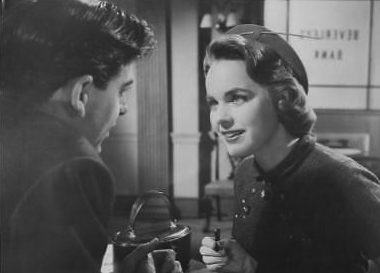
Two men (Robert Beatty, William Sylvester) are shocked to learn that their brother was killed in a car-crash in Italy. They are even more taken aback when they begin to suspect that his death was not an accident, but linked to his inquiry into a criminal organisation. Add a girl (Terry Moore) supposedly killed with the sibling but quite alive, a mysterious postcard, and a dogged police inspector (Geoffrey Keen) and you have the makings of a crime film about smuggling and murder.


The principal aspect of Postmark for Danger that struck me was that it was a pretty simple story made entertainingly complicated by the script. Characters whom the viewer thinks are little more than extras re-appear later; not all the villains are connected to the main group of criminals; developments are left as unexplained to the audience as to the protagonists - at least until a new twist sheds more light.


A good example of the writer (the prolific Francis Durbridge) treating his viewers with respect is an attempted blackmail angle: it falls through, seemingly without reason, though we learn why afterward only by inference, and that in two parts. It’s true that not all the red herrings have a purpose. Why, for instance, was the bottle of Chianti received at all? But by and large, the twists and turns make sense and form an enjoyable maze for the audience.


The acting is of the usual competence to be found in British movies of the 1950s, though the two leads are a Canadian actor and an American actress. Interestingly, Beatty and Sylvester worked together in Albert, R.N., recently reviewed in this blog, and would collaborate in the much better known 2001: A Space Odyssey. Beatty makes a likeable and sympathetic hero, especially when everything that happens to him comes across as fantasy to the increasingly exasperated Keen. The latter, for his part, portrays a sharp detective who, despite the evidence, keeps giving Beatty rope - not to hang himself but to prove himself innocent. This sort of character was common in British crime films.


Though no classic of cinema, Postmark for Danger (adapted from Portrait of Alison, a three-hour tv series of the previous year) is a fun and interesting movie of intrigue and crime. You can invest as much or as little thought in it as you like; it will be entertaining in any case.

Tuesday, April 2, 2019

A Window in London (a.k.a. Lady in Distress) (1940)

Directed by Herbert Mason; produced by Josef Somlo


On his way to work one day, a crane-driver (Michael Redgrave) witnesses what he believes to be the murder of a woman (Sally Gray) by a man (Paul Lukas). Quickly summoning a policeman, he discovers that what he saw was merely the rehearsal of a stage-act. But as events pile up, and he is drawn into domestic turmoil, the innocent Samaritan may wish murder was what he had seen after all.


A Window in London is part melodrama, part crime story and part romance, with a dose of comedy. It concerns two couples, but to write that it centres on their marital troubles would be misleading, though it does, in fact, do just that. The story continues through the film at a good pace, introducing a rather large number of characters and managing to make them all fairly realistic. Redgrave may seem miscast as a working-class man, but his accent and the nickname he is affectionately given by his colleagues - ‘the Duke’ - suggests that his origins are elsewhere.


The writing moves from labourers’ banter to a party scene at a high-class entertainer’s flat, and seems equally convincing in both worlds. Motivations are particularly well-handled: the ease with which Redgrave becomes involved in romance with Gray, while his wife (Patricia Roc) is at home reflects their two year (!) dilemma of working alternating shifts, she during the night and he during the day, and therefore rarely seeing each other.


The direction is good, making use of outdoor locations to a greater extent than many movies of the era: Redgrave’s character is working on the reconstruction of Waterloo Bridge, a project that was on-going through the 1930s. (Though produced in 1940, the film makes no mention of the Second World War, so it should be assumed to take place in the few years prior to the conflict.)


While A Window in London may be a bit ordinary for some, a bit too melodramatic for others, those who stay with it will be satisfied, and probably not expect the ironic finale.

Tuesday, March 26, 2019

Jigsaw (1949)

Directed by Fletcher Markle; produced by Edward J. and Harry Lee Danziger


After two murders, including that of a friend, are linked to an extremist political group, an assistant district attorney (Franchot Tone) in New York City pushes for an investigation. This doesn’t sit well with the people behind the crimes, people who stand to make a great deal of money.


This is what movie reviewers, both professional and amateur, call a ‘bad movie’. The premise provided a good set-up but nothing that followed was of high quality. The story veered away from exciting possibilities almost immediately, the writing was mundane (with the exception of a brief discussion of how ‘ignorance is big business’), the acting was below average.

Tone was a good actor, but here, possibly under uninspiring directing, his emotions are half-hearted or misaimed, his timing is off and his credibility flawed. Other actors, with the exception of Winifred Lenihan (who seemed to contribute nothing more to motion pictures than this performance) and Marc Lawrence as a political fixer, are wooden, overly dramatic and unbelievable. Jean Wallace and Betty Harper (later known as Doe Avedon), Tone’s two love interests, are dreadful.


Tone’s character was at least interesting, though not, I suspect, in the way the writers hoped. He was almost amoral, rather than righteous (quite a difference). He not only blithely cheats on his fiancée, but accepts backdoor help from dubious sources to gain a position as a special prosecutor. And when a woman with whom he was romantically involved is found dead a few feet from where Tone was knocked unconscious, he, after being told of the death, doesn’t even bother to check for a pulse, but immediately calls his office to arrange for a crime-scene team to be despatched - he, on the other hand, is off to follow another lead. In fairness to Tone’s character, I think this was simply sloppy writing.


The story was set up to pit Tone against what sounds like a neo-Nazi group (complete with uniforms), but it quickly turns into a crime-racket tale, with the powers behind the would-be extremists simply looking to make money. Any risky narrative about racism and discrimination is quickly forgotten. The actual dialogue ranges from forgettable to laughable. I lost count how many times Wallace answered a question with a question. It reminded me of an episode of the old Bob Newhart Show, when, for some reason, both Bob and Emily would repeatedly reply to each other’s statements with “Do you, Bob/Emily, do you really?” That was funny. Then again, so was the similar tactic in Jigsaw. It just wasn’t deliberately amusing.


The finale involves a shoot-out, which isn’t badly handled, but why a couple of the gunmen even participated, when they could have escaped unnoticed, is beyond me.

The strangest aspect of this movie has to be the inclusion of high-powered personalities in cameo spots. Henry Fonda has a line as a waiter; John Garfield appears for a few seconds; actors Burgess Meredith, Everett Sloane and Marsha Hunt all contribute minutely, while real-life society columnist Leonard Lyons shows up, too. Marlene Dietrich has a moment that actually makes sense (at least in terms of the result of her appearance, even if it doesn’t explain the reason): she is shown leaving in disdain a night club which has the gall to call itself The Blue Angel.


The cameos and the beginning of the story suggest that someone meant Jigsaw to be an important indictment of growing intolerance in Hollywood and the United States, just a few years after the practical lesson of such hatred was given by Nazi Germany. What resulted, however, was an ordinary movie, executed in a sub-ordinary fashion.