Followers

Friday, July 2, 2021

16 Blocks (2006)

Directed by Richard Donner; produced by Randall Emmett, Avi Lerner, Arnold Rifkin, John Thompson, Jim Van Wyck

Jack Mosley (Bruce Willis) is a low-level New York City police detective who’s lost whatever enthusiasm and ability he may have had in regard to his job. His colleagues recognize this, and he’s given such tasks as baby-sitting a crime scene, and escorting prisoners to court. This day, he must take witness Eddie Bunker (Mos Def) to a grand jury just sixteen blocks away. Within minutes, though, he realises that his task is not so mundane, as an attempt is made on his charge’s life, and Mosley finds that even his best friends can’t be trusted. All he can rely on is a petty crook he’d just met, and twenty-five years of police experience he’s mostly forgotten.

From the start, we can dispose of the plot, which is not original, and serves mainly as a platform for the action. Some reviewers have compared 16 Blocks to The Gauntlet (1977), directed by Clint Eastwood. Though both movies feature an attempt by a burned-out but decent cop to deliver a witness against overwhelming odds, the events of the earlier film are almost absurd in their exaggeration, and The Gauntlet is probably best remembered for the prodigious use of ammunition by the police characters. Both movies feature a city bus the hero takes over, and this may contribute to the comparisons.

16 Blocks certainly has its share of contrivance, but is rather more realistic. The action is more down-to-earth, and the reasons for Mosley being considered a target for his colleagues more sensible.

The direction, by veteran Donner (Ladyhawke, Lethal Weapon) is a cut above average, providing plenty of excitement and thrills, but also some good, quieter moments, especially for the two main stars. There are, perhaps, too many scenes involving a trick in which the viewer is misled into thinking people are in one room when they are in another, but by and large Donner delivers effective work. There is also excellent use of New York City locations.

It is, however, the two leads who provide the best reasons for watching 16 Blocks. Willis, whom I don’t favour all that much as an actor, gives one of his best performances here. Noted for playing policemen, or some other type of character with a gun, he is also noted for his roles’ sarcastic lines and smirking delivery. There is none of that here.

Mosley is an alcoholic with a bad leg, fed up with his job and, more so, with himself. He is out of shape – his ‘spare tire’ isn’t typical of Willis’s characters – with any sense of humour he may have had buried by apathy and disdain. I can’t think of a single smart-alecky thing he says and, in fact, the most telling moments for Willis in the part are the silences. There is a good moment in a bar when Mosley realises that he is suddenly in an horrendous situation, and no matter what he does he will probably lose.

Def, known mostly as a hip-hop performer, does very well in 16 Blocks, even if he is hard to understand sometimes. A small-time criminal, his Bunker is a rather nice guy, too loquacious perhaps, whose ambition is to become a baker, specializing in birthday cakes. Willis and Def have a very workable chemistry in the film.

The other actors in 16 Blocks don’t have much to do except for David Morse - who plays Mosley’s former partner and chief opponent – and Jenna Stern (actress Samantha Eggar’s daughter), who portrays Mosley’s supportive sister.

An entertaining action flick, 16 Blocks wisely avoids extraneous sub-plots and concentrates on Willis, Def, gun-play and chases. It should satisfy most adventure fans while providing a modicum of depth that is not out of place.

Sunday, June 27, 2021

Hondo (1953)

Directed by John Farrow; produced by Robert Fellows

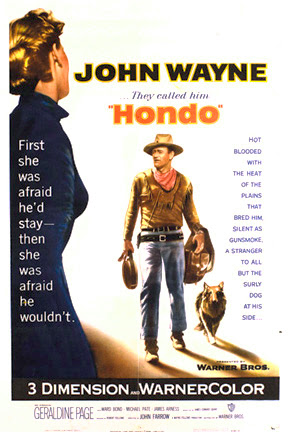
Hondo Lane (John Wayne) trudges in to an isolated ranch having survived an Apache attack in the desert. He meets Angie Lowe (Geraldine Page), who is running the ranch with her little son (Lee Aaker) in the absence of her husband (Leo Gordon), and quickly establishes a rough rapport with her. Their mutual attraction is, however, subject to a number of factors, including hostile cowboys, patrolling soldiers and raiding Indians, whose leader (Micahel Pate) develops a proprietorial interest in Mrs Lowe’s seemingly fatherless boy.

Right away, one might note a similarity in at least the premise of Hondo to Shane, which was released in the same year. Given the star of the former movie, one might also rightly expect Hondo’s canvas to be broader than Shane’s, and its attitude to be less introspective. Both films are successful, however, though Hondo works almost exclusively because of Wayne.

Wayne’s character is one of his most interesting. Hondo is a very practical man; certainly not politically correct, he strikes the viewer as a fairly realistic interpretation of an individual raised on the frontier, where sentiment may exist but takes no part in decisions. For instance, Hondo explains how his dog, a semi-feral collie, was trained to “smell Apaches”; the process involved an Indian beating a puppy until it recognises its tormentor’s scent. This explanation horrifies Mrs Lowe, who inadvertently embodies the different attitudes of later times.

Hondo, while eminently practical, is also a romantic, describing how his late wife – an Apache girl – had a name the meaning of which cannot fully be comprehended in English, and comparing it to how a person feels while watching dawn arrive or sensing the first winter breezes off the mountains. These feelings are not entirely subjugated to the real world. Hondo’s unwavering devotion to honesty is, ironically, contested by Angie’s assertion that honesty is not always the best policy. These contrasting qualities between, and in, the two characters make them deeper than what one might initially suspect them to be.

In contrast to Wayne, who, though he won an Oscar (for his part in True Grit (1969)), is not noted for his acting range (some might substitute ‘talent’ for the phrase), Geraldine Page’s performance in Hondo was thought highly enough to be nominated for an Academy Award. I cannot agree with the nomination. I think her acting here is unconvincing, and not up to Wayne’s. There is nothing that really stands out about it as bad, but almost all of her lines seem uttered in a high-schoolish fashion. Katherine Hepburn was the original choice for the role, and I can only think wistfully of what she might have made of it.

The story is not complex, but it does involve more than a few events, one leading fluidly into the next. It is based on a Louis L’Amour short story, “The Gift of Cochise”. Some reviewers have written that the movie is the most faithful adaptation of a L’Amour work; I believe the short story was greatly expanded with much original – or at least, new – material. L’Amour later wrote a novelisation of the movie, based on its script. This may be from what some people think the film was derived (rather than vice versa), in which case there is no wonder that it runs so closely to the movie.

The depiction of Indians in Hondo is unsentimental. Like the title character, they are products of a hard environment and cannot afford sentiment dictating their actions. They are villains by circumstance. They attack settlers, and therefore they must be fought. But as Hondo himself states, whites broke the treaty that had been made with the Apaches. At one point, Vittorio, the Apache leader, states that his sons are all dead; since he himself is hardly middle-aged, it seems likely they were killed young, perhaps as children, by whites.

Hondo has great sympathy for the Apaches and their way of life; he lived among them. His dog’s ability to smell them is hardly racist: Hondo demonstrates how he himself can smell Angie Lowe, thanks to her baking and washing. (American long-range reconnaissance team-members in Indochina would sometimes eat indigenous food and refrain from  washing before patrolling, so their American scent wouldn’t give them away.) Though individuals might be heroic or villainous, the whites and the Indians in Hondo are shown neutrally, simply as people who want to get by, their cultures and their respective need for land making conflict inevitable.

While the story does not contribute to the most exciting feature of Wayne’s career, it does furnish an entertaining film, with some exciting action scenes, and his character provides interest. Together, they make Hondo a superior entry in the western genre.

Sunday, June 20, 2021

No Way Out (1950)

Directed by Joseph L Mankiewicz; produced by Darryl F Zanuck

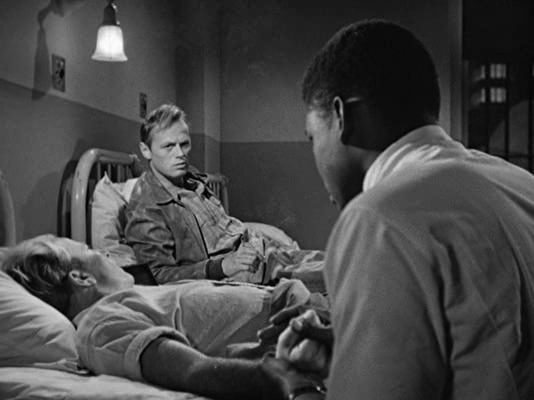
Two would-be robbers, The Biddle brothers, are brought to a metropolitan hospital, each suffering non-life-threatening bullet wounds from a policeman who interrupted their heist. A new doctor, Luther Brooks (Sidney Poitier), suspects something less obvious is killing one of the Biddles but, despite his treatment, the patient dies. The surviving brother, Ray (Richard Widmark) – a rabidly racist white man – rages against the young surgeon – a black man – but can do nothing. That state of affairs doesn’t last long as he begins his plan for deadly vengeance.

One of the most hard-hitting movies about racism to come out of Hollywood was among its first: No Way Out pulls no punches in either its depiction of ethnic hatred or its consequences. Nor does it soften the language that racism employs, language that I suspect a twenty-first century movie would be afraid to use, for all the modern era’s claims to sophistication. The director co-wrote the screenplay with Lesser Samuels and, while the brutal words command attention, there is also a subtlety in the script that might escape notice.

This was Poitier’s first credited movie role (hence his fourth place in the billing, after three performers much better known at the time) and, though so young he resembles an adolescent, his talent is clear. His character could have been little more than a two-dimensional victim, but the writers and Poitier create a real person who evolves quickly amid the frantic events of the film. Brooks is unsure of himself as yet; despite his claim of a thick skin, he is affected by Biddle’s taunts, and by the pressure of his new position. How he resolves his uncertainty is unexpected but logical.

Widmark could have swamped Poitier’s part with an exaggerated performance; the script, Poitier and Widmark himself prevent it. As a consequence, the villain comes across as human but, in being cunning rather than intelligent or even clever, he shows a bestial aspect that fits with his personality. Ray Biddle is supremely sure of himself, one of the many contrasts to Brooks: his certainty and Brooks’s see-saw back and forth in inverse proportion to each other’s.

Linda Darnell and Stephen McNally (the latter in a rare good-guy role) have supporting parts, but both are crucial to the story and to the story’s aim. Darnell plays a former wife of the dead robber, while McNally is the hospital’s chief resident, and Brooks’s strongest supporter.

In the four characters assumed by the actors, No Way Out demonstrates different aspects of racism. Brooks’s place is obvious, even if his reactions are three-dimensional. Biddle’s place seems equally patent, though we see his neighbourhood (“Beaver Canal”) and how he likely had little chance of being anything but what he is. His literally fevered cries of resentment over being ignored and unloved could be the pleas of a thousand Beaver Canals around the world; streets and slums left to wallow in misery.

Edie Johnson (Darnell) is, perhaps, more common in society than the other major characters. Basically decent, she too was raised in bigotry, and stays there because it makes a shallow sense to her. Confronted by the destruction she helps to cause, however, she rebels; still full of anger, but at herself as much as at anyone else, her attempts to ameliorate the situation may be too little too late.

Just as plentiful in the world are people like Dr Wharton (McNally), a truly good man, but one who can afford to be good. He has a fine job that he loves, a nice house, more than sufficient income. As well, his duties permit him to skirt moral issues. The hospital’s director, Sam Moreland (Stanley Ridges), makes a decision that would refuse peace of mind to Brooks and possibly damage his reputation, but does so in order to keep the good name of the hospital, ensuring the funds for life-saving equipment keep coming in. Dealing with politicians and self-serving bureaucrats, he remarks that in his case M.D. stands for ‘Master of Double-talk’, and urges his subordinate to “keep wearing that white coat”: practice medicine, not administration. Moreland’s sacrifice of principles allows Wharton to maintain his. Yet it’s telling that Wharton employs a black maid.

Other elements of racism are shown in Brooks’s family, in the gang that hangs out at the Beaver Canal pool-hall, even in the casual talk of hospital staff (“I heard the hospital had one [a black doctor]. This must be him.”) Expertly, there is no condemnation levied by the movie; it shows us human beings and lets the audience judge them, or not. There is more understanding of people in these characters than in any number of psychological studies.

But for all the talk and acting, No Way Out is also an excellent drama, full of tension. The preparation of two groups for a pitched race riot is breath-taking, and the climax is a stand-out.

No Way Out is one of the best of Hollywood’s movies about ethnic hatred, joining Intruder in the Dust, from a year earlier, in that category. While the latter depicts a terrifying, sad world of victims and perpetrators, No Way Out shows a frustrating one, in which the victims of one day might be the perpetrators of the next.

(Poitier and Widmark co-starred again in 1964’s The Long Ships, as different a film from No Way Out as one might get, with very different characters, as well. They were also in 1965’s The Bedford Incident.)