Followers

Thursday, January 6, 2022

I See a Dark Stranger (a.k.a. The Adventuress) (1946)

Directed by Frank Launder; produced by Sidney Gillat and Frank Launder


Irish girl Bridie Quilty (Deborah Kerr) has been brought up on her father’s stories, or, rather, story, of brave deeds in the Easter Rebellion against the British, despite the fact that most people simply humour the man and his fantasy of being a hero. A few years later, as a young woman in 1944, Bridie leaves her native village for Dublin, where she tries to convince her father’s alleged old comrade to enrol her in the Irish Republican Army. The veteran revolutionary, however, now prefers peace and negotiation. Bridie is disgusted at his ‘softness’, and an encounter with a stranger on a train allows her to join the current war against Britain. But the young woman soon finds that being a spy is not all adventure and excitement, and she soon has reason to regret her thoughtless and childish ambitions.


A movie about a British-hating Irish nationalist aiding German spies is an unlikely film to be made just after the Second World War, but the team of Gilliat and Launder were rather daring in a quiet, unobtrusive English way.


Though Irish nationalist aspirations are treated understandingly here, Bridie’s revolutionary fervour is shown to be what it is: the immature dreams of an innocent. This helps the film tremendously, as does the three-dimensional portrayal of all the major characters, and even most of the minor ones.


Kerr does an excellent job rendering her character and softens some of what may have been abrasiveness in other hands (Bridie’s naïvté can be a bit annoying at times). Trevor Howard gives good support as an academic in the war-time role of army officer, who is alternately perplexed, exasperated and enamoured of Bridie.


Perhaps not oddly, considering the producers, it is the secondary characters and those who portray them that stand out. Raymond Huntley (also seen in Pimpernel Smith and Night Train to Munich, both of which I recently reviewed) has an excellent role as a wry, dry German spy, while Garry Marsh and Tom Macauley are droll as two security officers, who might actually be satisfactory at their duties, if they applied themselves.


The script is sharp and, though not as witty as some of Gilliat and Launder’s work, is intelligent and entertaining. It leavens what could have been a heavy subject with humour, never out of place, and is dominated by chance, throwing spanners into plans. (For instance, Huntley is a cool and smart operator, but when he gets one thing wrong, it causes confusion and anxiety for Bridie.)


A month ago, I reviewed State Secret, produced by Launder and Gilliat, and directed by the latter. His work was good but not excellent. Launder is in the director’s chair this time, and the pace and involvement are noticeably stronger. This may be due to other causes, of course, but I See a Dark Stranger benefits from a director who seems to know the benefits of keeping things going.


An unusual drama, with touches of comedy, I See a Dark Stranger is propelled by good performances, writing and direction, the ingredients for success.

Thursday, December 30, 2021

Cover Up (1949)

Directed by Alfred E Green; produced by Ted Nasser

Insurance investigator Sam Donovan (Dennis O’Keefe) arrives in Marlowe City to look into the suicide of Roger Phillips. The first thing he notices is Anita Weatherby (Barbara Britton), who travelled in his compartment of the train to Marlowe, coming home for Christmas. The second thing is that no one in town seems too concerned with Phillips’s death. This includes the county sheriff (William Bendix) who, while not obstructive, is certainly not helpful. Donovan quickly learns that the suicide’s corpse had no powder burns – suggesting that he was shot from a distance – and no firearm was found at the scene. Donovan just as quickly suspects murder, but with an apathetic lawman and plenty of suspects, his Christmas probably won’t be merry.

Despite some flaws, Cover Up is rather a nifty little mystery. The acting is good (Hank Worden, credited as Worden Norten, appears as an undertaker), the direction adequate. The premise is excellent, with a set-up that makes the viewer wonder just what is going on.

Cover Up’s principal liability is the script – which, ironically, is also its best asset. First, one must wonder why an insurance company would send anyone to look into a suicide. Suicide cancels any payment on a death benefit, for obvious reasons. So, with the official verdict on the company’s side, and the company saving money because they wouldn’t have to pay out, nobody should have been sent to Marlowe to investigate.

This illogic is increased when Donovan’s boss insists that he prove Phillips’s demise was due to murder, despite a double indemnity clause that would give twice as much cash to a beneficiary as would normally be the case. It would have been much better – and easy – for the writers to have made Donovan a private detective, hired by a distant relative of Phillips, or perhaps a nosey reporter sniffing out a story.

Another flaw is that the movie does not ‘play fair’ with the audience, laying out the clues necessary for the solution of the mystery. There is no reason why a film must do this, but the structure of the story suggests that the usual whodunit’s rules were being followed. As well, the dead man is described by a character as ‘a blight’ on the community. However, aside from opposing his niece’s marriage (possibly for a good reason, for all we know), his heinous acts go untold.

Even with these not insignificant items, the script (co-written by star O’Keefe under a pseudonym) does pretty well. It builds an atmosphere that reflects the slight unreality in which Donovan finds himself, trying to interest people in a death no one cares about. His romance with Anita is not unconnected to the story, and a small-town feeling is successfully created.

The best part of the story is the fact that even as it nears a climax, the viewer will probably be kept from successfully deducing the truth. The multiple suspects and a second death that comes conveniently soon after the first may or may not be red herrings.

Cover Up certainly isn’t a top-grade crime drama; it’s writing is not neat enough for that. It is not good film noir, either, though I don’t believe it was attempting to be. It is, nonetheless, an entertaining and involving movie. And in that, I think, its makers succeeded in doing what they intended.

Thursday, December 23, 2021

I'll Be Seeing You (1944)

Directed by William Dieterle; produced by Dore Schary


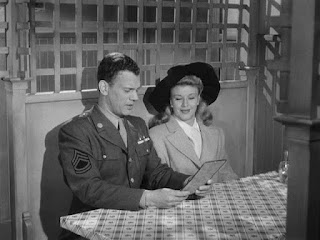
Zach Morgan (Joseph Cotten) is a U.S. Army sergeant given leave from his hospital for the Yuletide. He had been bayoneted, but his wounds go beyond the body: he is suffering psychological trauma from his experiences; recovering from them, he hopes. Mary Marshall (Ginger Rogers) has been granted a ten-day pass from prison, where she is serving a six-year term for involuntary manslaughter. When they meet, they share an immediate affinity, but neither wants the other to know from what they have just come. As their relationship deepens, it becomes more and more difficult to keep their secrets, yet they feel they must, even so.


Cinematic romances are the rockiest in all the universe. After all, if it were not for the difficulties an otherwise happy couple encounters, there would be no drama - or comedy - and no movie. Often, the barriers to a smooth relationship are contrived, though this does not mean they are unconvincing. In I’ll Be Seeing You, only half the tribulations are contrived: after all, the number of convicted female felons on parole from their prisons in the early 1940s must have been limited, especially at Christmas-time. The number of shell-shocked soldiers was, unfortunately, rather greater. Nonetheless, the two leads, the writing and the direction pull off a winning, if not noteworthy, production.


Cotten does an excellent job of making his character realistic, and making his affliction realistic. One wonders if the studio was hesitant to portray a soldier with psychological problems. If so, Cotten’s down-to-earth, likeable yet strong personality probably reassured everyone. Certainly, he portrays Zach Morgan entirely sympathetically.


Rogers does just as well in her role. There is a moment when Mary is trying to explain to her aunt (Spring Byington) that she can’t rely on having even the ordinary dreams that most women have, dreams - such as marriage, a small house, children - the realisation of which is perfectly feasible. Her aunt understands to an extent, but Mary’s attempts to convey her feelings trail off, as if she knows it’s easier, and less hurtful, just to nod and agree. Her life, as she sees it, will be one of just getting by.


The other actors are very good, too. Other reviewers have mentioned that Shirley Temple, as Mary’s cousin, Barbara, is annoyingly immature one moment and insightfully intelligent beyond her years the next. Well, Barbara is seventeen. She’s trying to be a woman but isn’t there yet, so her efforts are self-conscious (she describes the low neckline of her new dress as a ‘morale-builder’) and only intermittently successful.


Byington (to whom Temple’s resemblance adds verisimilitude to their movie relationship) and Tom Tully, as Mary’s aunt and uncle, are neither the wise elders nor the bland cardboard cut-outs viewers might expect. They are supportive of Mary, a little awkward in an unfamiliar situation, but probably more typical of people of their era and class than many other characters. They are also lively, enjoying a fun evening out, younger than their ages.


The writing is of two halves. The romance is fairly routine for movies: two people meeting by chance and falling in love over a very short time, despite not knowing a great deal about each other. But in dealing with their respective problems, the script is very good, especially in Morgan’s case.


There is an instance when he and Mary are watching a war-movie. Morgan’s reaction is one that combines embarrassment, disappointment and physical discomfort (note the perspiration he sweats.) Interestingly, he doesn’t condemn the film (perhaps the studio making I’ll Be Seeing You had made a few war movies itself) but explains that it isn’t how soldiers view a war. And Morgan’s later panic-attack later must have been written by somebody who had experienced one.


There is also an attack by a vicious dog which, though neither man nor best are hurt, must have conjured up for Morgan memories of hand-to-hand combat. Though nothing is said of a comparison, Cotten’s face made such a statement unnecessary.


It is hard to separate the work of writing, directing and acting in these moments, but the last two in particular raise I’ll Be Seeing You above the average. And one wonders if it did a favour to thousands of battle veterans who at last had a graphic example of what they were going through, and whose loved ones felt that they could broach the subject, after observing it handled so well and sympathetically. If I’ll Be Seeing You was not the first movie to show such things - and to show understanding to an almost exclusively female dilemma in Mary’s crime - it must been a very early example.

Thursday, December 16, 2021

Short Time (1990)

Directed by Gregg Champion; produced by Todd Black


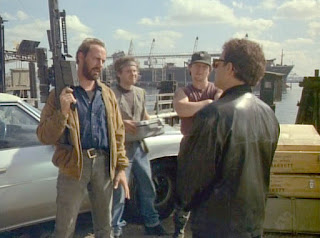
Burt Simpson (Dabney Coleman) is a veteran cop eight days away from retirement; he is good  - if not superb - at his job, still loves his estranged wife (Teri Garr) and is devoted to his son (Kay-Erik Eriksen). His fairly complacent life is turned upside down, however, when his doctor tells him that he has just weeks to live. Simpson receives another shock when he learns that his police life-insurance policy will pay out much more if he dies in the line of duty. With nothing to lose and a secure future for his family to gain, Simpson sets out to be killed. But that turns out to be considerably harder than he thinks.


I have a fondness for watching movies that feature as leads players who are otherwise considered character actors. That’s not to guarantee that I will like those movies I watch, but I want to give them a chance. I think it appeals to my liking of the obscure.


In Short Time, Coleman has, I believe, his sole starring role in a motion picture. He is much better known as a supporting performer in the cinema and as a prominent star in tv series. He frequently plays unpleasant people, villains - though rarely vicious or violent. Even his ‘good guy’ roles, if one can call them that, are sarcastic, vitriolic, if dry-humoured, men, such as the characters he played in the tv series Buffalo Bill and The Slap Maxwell Story.


Short Time gives Coleman quite a different part to play. It’s true that he is, again, sarcastic, given to snide comments and muttered insults, but he is definitely a good guy, without quotation marks. Burt Simpson is loyal - to his job and his wife - conscientious and respected. The movie gives Coleman a chance to show that he can act, and create a sympathetic character. There is a moment when he is driving with his young son, and exhibits true joy at getting to know a side of his boy he may not have known before.


Unfortunately for the movie, Coleman is the only real attraction. Matt Frewer and Barry Corbin give good support as Simpson’s partner and boss, respectively; both bewildered by the sudden dare-devil attitude of their formerly cautious comrade. But Garr is wasted in the thankless role she is often handed, that of the slightly harried wife and mother. Xander Berkeley is a cartoon as the villain of the piece.


The writing is rather uneven, depending, like the film as a whole, largely upon Coleman. There is enjoyable humour in Simpson’s growing frustration at the inability of criminals to kill him. But beyond the star, the offerings are sparse.


The direction is adequate; there is a funny, enjoyable car-chase scene - no one in films is less grateful than Simpson is for seat-belts - but otherwise the work is pedestrian. This movie plays like a tv movie with a slightly bigger budget than average and stronger language.


While it may seem that I am damning Short Time with faint praise, there are some good elements to it. They all, however, come from the star, who certainly proved himself to be watchable and capable of more than supporting roles; indeed, he holds this movie up by himself. And that, unfortunately, is Short Time’s problem.

Wednesday, December 8, 2021

State Secret (a.k.a. The Great Manhunt) (1950)

Directed by Sidney Gilliat; produced by Sidney Gilliat and Frank Launder

John Marlowe (Douglas Fairbanks Jr) is a pioneering surgeon who has been invited to the central European nation of Vosnia to demonstrate an innovative technique to the country’s top doctors. This includes a practical demonstration on a patient. Though Vosnia is a totalitarian dictatorship, Marlowe sees the invitation as a way of opening the land up to outside influences. Things become uncomfortable for Marlowe, however, when he learns that the patient is actually Vosnia’s ruler, General Niva. And things become deadly when post-operative complications put Niva’s life - and Marlowe’s - in danger.

State Secret is an entry in the ‘man on the run’ film genre, in the tradition of 1935’s The 39 Steps, and others. Gilliat and Launder had written similar, and successful, fare previously, in The Lady Vanishes and Night Train to Munich. This later movie is produced by the partners’ own production company, and written by Gilliat alone. Though good, it doesn’t quite measure up to its predecessors: there is a crispness lacking in the script (perhaps that was Launder’s contribution in the past) and a connection among the performers.

The acting itself cannot be faulted. Fairbanks does very well as the earnest doctor, pleased with his work and happy to share it with others. His behaviour under stress - possibly facing death - is credible and involving. Jack Hawkins has an excellent part as a Vosnian government minister, Colonel Galcon, a polite, urbane man who thinks nothing of massacre, if it suits the needs of his masters. Glynis Johns is entirely believable as the young music-hall artiste who is roped into helping Marlowe along the way.

One of the problems is the chemistry between Fairbanks and Johns. There is none. Fairbanks, looking older than his 41 years, and Johns, looking younger than her 27, interact well, but there is no indication that their characters even really like each other, never mind have a spark that even a platonic relationship must have to be entertaining.

There are hints that their shared adventure might result in romance, but the script didn’t push that, as if realizing that the audience wouldn’t buy it. There is, in fact, more fascination in the cat-and-mouse actions and words between Marlowe and Galcon.

The writing makes use of a deus ex machine that, while providing irony, is as unsatisfying as it is unexpected.

Even so, the story will keep the viewer interested, even if the script does not. The actions of the authorities in the police state are realistic and create a genuine air of fear and suspense. The use of words such as ‘deviationist’ and ‘crypto-fascist’ to describe enemies of the state imply that it has a communist regime. As well, Marlowe says that he planned to visit Vosnia back in 1939, to which a Vosnian official replied that much has changed since then: the countries of eastern Europe were forced into communism immediately after the Second World War.

The direction is good, though not very good. There is a pointless sequence near the beginning in which, through a flashback, Marlowe explains the origins of his situation. For several minutes, we see the action through his eyes, only to have that viewpoint abandoned.

The location shooting, probably in Croatia or northern Italy, is very well used, and not the usual setting for movies. Another aspect of the film that aids it tremendously is the use of the Vosnian language. There is no Vosnian language, any more than there is a Vosnia. The language was made up for the movie, from Romance languages (probably Italian, from the looks of how it’s written) and Slavic. Unlike many films, which create a few words in a fictional dialect, State Secret’s script has whole conversations in Vosnian, between dozens of people, most of them bit-players. This, and the physical setting, makes Vosnia seem real. Cleverly added is what sounds like the Vosnian national anthem, which serves as the theme music.

There are some very good moments in State Secret. Scenes such as those in the high mountains, and when Marlowe first realises his predicament, are tense. Herbert Lom, as a black marketeer, provides some grim comedy and a different perspective on the film’s events.

State Secret can’t compare with the more enjoyable, earlier products of the Gilliat-Launder partnership, but it is a good adventure movie, realistic and adequately exciting.