Followers

Sunday, March 19, 2023

Larceny (1958)

Directed by George Sherman; produced by Leonard Goldstein

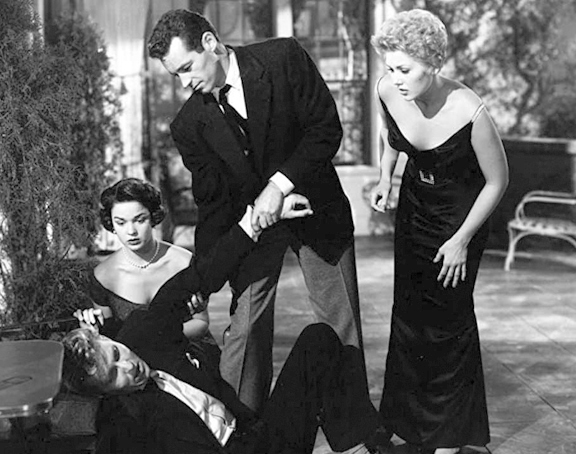
Flushed with a recent success, big-time confidence-men Rick Maxon (John Payne) and Silky Randall (Dan Duryea) embark on their next venture: the fleecing of a small city in California. They hope to achieve this by embroiling the daughter (Joan Caulfield) of the city-manager in a financial scandal. Things become unexpectedly complicated, however, when Maxon begins to develop feelings for the girl, while Silky’s girl, Tory (Shelley Winters), declares her feelings for Maxon.

Larceny is a pretty average crime film, as bland as its title. The story is predictable: as soon as Silky shows Maxon a photograph of his target, the audience knows that emotions will cause unforeseen difficulties – unforeseen by the crooks, not the viewers. Some interest is generated by the flighty and selfish actions of Winters’s character, but everything moves along according to schedule.

If the story is ordinary, the script provides some amusement, mainly in the tough-talk exchanged among Maxon, Silky and Tory. It’s not grade-A dialogue, but it gives a few good moments.

It’s the players, however, who provide the principal entertainment. Payne is a good lead in most of his movies, capable of shifting between villain (usually the kind heading for redemption) and hero (note the growing idealism of his lawyer in Miracle on 34th Street), even if his rôle here does not compel him to any great feats of acting.

Duryea is always dependable when cast as a heel; here, he is suitably oily, ready even to forego killing a hated enemy in order to turn a profit. Winters often adds a disadvantageous abrasion to a film, but in Larceny, she is the wild card that provides the few twists to the plot – though none of them turn it from its pre-destined course. Dan O’Herlihy, in only his third feature, plays a gentle and easy-going member of the criminal gang.

George Sherman was nothing if not prolific behind the camera, directing a large number of movies in the late 1930s and the ‘40s, half a dozen or more a year. None was really of note, however, except for a couple of John Wayne features, late in the director’s career. Westerns occupied most of Sherman’s time, but Larceny is probably typical of his style: workmanlike but unremarkable.

While it confirms that terms such as ‘grifter’ and ‘sting’ were really used in the 1940s – though whether by genuine con-men or not remains unknown - Larceny is neither very bad nor very good, and is stuck in the low-budget limbo of the time-filler.

Sunday, March 12, 2023

Grand National Night (a.k.a. Wicked Wife) (1945)

Directed by Bob McNaught; produced by Phil C Samuel

Gerald Coates (Nigel Patrick) is a successful horse-breeder and trainer whose horse has just won the Grand National. He also has an unfaithful, alcoholic wife, Babs (Moira Lister). The night of the race, his relationship with his spouse reaches a climax, and she doesn’t make it to the morning alive. Coates tells a sympathetic friend, Joyce (Beatrice Campbell), that he killed Babs, and the two watch as the investigation, headed by a determined police detective (Michael Hordern), closes in on the guilty party.

A neat little crime film, quite English, Grand National Night benefits from a number of elements, starting with the acting. Patrick makes a sympathetic protagonist, and Lister a suitably off-putting victim. Both make their characters human and imperfect, while maintaining their principal traits. Patrick was a very popular leading man in British film of the day, though most of his pictures seem to fall into the B category, and, unfortunately, are largely forgotten today.

Campbell and Patrick have a natural affinity for each other; perhaps not surprising, as they were married in real-life, remaining so for nearly thirty years. They were in more than one movie together. With the exception of Hordern, the other cast-members are unknown now, and may have been then. But, as is the way with British character actors, they feel perfectly at home with their parts, adding considerably to the movie.

(Richard Graydon (credited as Richard Grayden), who plays the groom, Chandler, was a very minor actor at the time. He soon found his calling, though, becoming a movie stuntman and stunt-coordinator, apparently at the age of forty. His credits in this line include many James Bond films (from Connery’s era to Moore’s); Raiders of the Lost Ark; The Charge of the Light Brigade (in which he played Lord Bingham); The Duellists (he’s the Russian Harvey Keitel’s character shoots); Don’t Look Now; The Wild Geese; ffolkes, and 1989’s Batman. He dealt often with horses.)

The story comes from a stage-play, and the script, heavy with dialogue, shows this. The writing is good, with bright moments, usually depicting character or humour (such as an instance when someone asks why a character called ‘Buns’ Darling is called ‘Buns’. The response is that ‘we can’t very well call him Darling’…) There is an example of what might be considered a deus ex machine, but in fact there are earlier clues as to its use, and the finale is, I believe, perfectly legitimate in a crime-film, if not in a mystery.

The handling of the characters, especially the principal two, is very good. Gerald might have come across as indifferent to his wife’s problems, but it is made clear that he has given her opportunities for reconciliation previously, and she has not made the most of them. As well, there are hints that their lives together were more frivolous before the war, when he was captured and incarcerated in a Japanese prison camp. For her part, Babs wants her marriage to work, but it is clearly not the relationship it was in the past; she can neither cope with that, nor change her destructive habits arising from it.

The direction has a dichotomy to it: in some ways, it seems rather self-conscious, using close-ups and zooms rather too obviously, perhaps trying too hard for a Hitchcockian element. On the other hand, the movie’s stage origins are effectively broadened, and satisfactorily adapted to the big screen. The setting is largely a horse-breeding country estate; advantage is taken of this to have a number of riding scenes, or scenes placed beyond the confines of drawing rooms and entrance halls.

Grand National Night is a good if minor thriller, benefitting from capable performances, decent writing and a feel for the English countryside.

Sunday, March 5, 2023

The Way to the Stars (a.k.a. Johnny in the Clouds) (1945)

Directed by Anthony Asquith; produced by Anatole de Grunewald

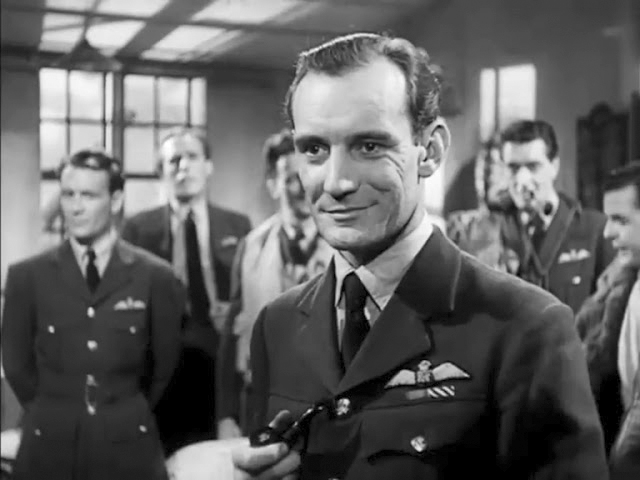
This is the story of a Royal Air Force station in the Second World War. It begins with the arrival of Pilot Officer Peter Penrose (John Mills), whose mere 15 hours flying in Bristol Blenheims grates on his superior, Squadron Leader David Archdale (Michael Redgrave). Eventually, however, the two become fast friends, Penrose matures into an experienced airman, and casualties take their toll. American flyers arrive, and missions become complicated. As the war goes on, drama, courage, hope, love, life and death make their changes.

Despite an opening sequence in which the station is bombed, The Way to the Stars (a title inspired undoubtedly by the RAF motto ‘Per ardua ad astra’) is more a movie about people in war, than about war, or about the war. It’s about what battle does to people, the bad things, and the good things that men and women manage to create in its midst despite its horrors. It might have been a stage-play (though it wasn’t), but the direction keeps the movie seeming like a movie.

That direction is deftly handled by Asquith, who had already made his mark by this time, and would go on to make it even stronger. This is one of his numerous collaborations with playwright Terence Rattigan - who wrote the screenplay, based on a story he co-wrote - and producer de Grunewald, who was Rattigan’s partner in writing the script.

That script weaves together personal and professional matters, demonstrating that while there may be differences between the two, they are inextricably connected, more so in wartime than in any other setting. This is seen especially in Penrose’s affection for a local girl, Iris (Renee Asherson), and his reluctance to take the relationship far. Penrose, Archdale and, later, the American Johnny Hollis (Douglass Montgomery), largely represent the service side of the story, while Iris, Toddy (Rosamund John) and Palmer (Stanley Holloway) are the civilians.

An interesting feature of the story is that none of the flyers is safe, whether they are major characters or minor, portrayed by established actors or neophytes. Cleverly, a highly-billed actor’s character is written out as killed, early on in the film, creating tension with the audience, who thus cannot be sure who will survive. This stress is particularly keen in the climax, featuring a badly damaged aeroplane attempting a desperate landing.

With the direction, writing and production in good hands, it would have been disastrous to have poor acting. This is no danger with the cast. This includes, apart from those mentioned, Basil Radford as the squadron’s non-flying recording officer, Felix Aylmer, Joyce Carey and David Tomlinson. Trevor Howard receives an ‘introducing’ credit – though he appeared, uncredited in The Way Ahead (as noted in that movie’s review on this blog last November), as does a 16 year old Jean Simmons. Simmons, unusually, doesn’t act but sings – delightfully - as an entertainer at a dance. So far as I can tell, her own voice is heard; she used it again in her much bigger rôle in Guys and Dolls.

All here is handled well. Rattigan, who served in the RAF during the war, captures the spirit of an air force base expertly, and uses the contemporary slang sparingly; enough to give the idea but not enough to confuse. De Grunewald’s experience in movies probably contributed to adapting any stage-like qualities of the script to film. Asquith’s direction keeps the story running smoothly, and Mills can’t be beat in showing his character’s evolution.

The Way to the Stars is another example of the excellent films produced in Britain during and soon after the Second World War.

Sunday, February 26, 2023

5 Against the House (1955)

Directed by Phil Karlson; produced by John Barnwell and Stirling Silliphant

Four law school friends (Guy Madison, Brian Keith, Kerwin Mathews, Alvy Moore) spend a weekend at Reno, where they witness an attempted robbery at a casino. Prompted by a security guard’s boast that stealing from the casino ‘can’t be done’, one of the quartet devises a plan successfully to do so. The others eventually agree to the scheme, which will actually carry out the theft – to prove an academic point – but result in the money being returned. One of the four, however, has a different intention for the cash.

5 Against the House may be one of the earliest movies depicting a heist, as opposed to a simple robbery. Perhaps prompted by The Asphalt Jungle, it in turn may have influenced other casino-heist films. As such, it is interesting, but the robbery itself is disappointing. The scheme is one unlikely to succeed even under ideal conditions; it relies on a gimmicky hidden ‘fifth criminal’, and a get-away that makes use of the railway that runs right through the centre of Reno. The possibility of such an escape route must have been realised by the police for years.

The real entertainment of the script – the first he wrote for a film by co-producer Silliphant, who went on to pen screenplays for In the Heat of the Night, The Poseidon Adventure, and other movies – is the dialogue among the four friends. It is light-hearted and genuinely funny, and gives the impression that these men are good pals. The part of the movie preceding the heist has little to do with the crime, which is being planned in the background, as it were; instead, we get to know the characters. They are interesting enough to make the robbery seem almost a detour. As well, one wonders how much these students are paying attention to their classes: Mathews states that, as long as the money is returned, there will have been no crime committed; these are would-be lawyers, remember.

The acting is good, especially by the always casual Keith, who nonetheless gives an edge of explosive menace to his character. (If he and Madison seem old for students, it should be noted that they play Korean War vets, who are probably going to university on a G.I. bill.) Moore is fun as the most comical of the four, while Kim Novak, in one of her earliest rôles, is convincing as the marriage-shy girlfriend of Madison’s character. Also seen is William Conrad in a surprisingly small part, and Kathryn Grant (Bing Crosby’s second wife) is uncredited as a former girlfriend of Keith’s character.

The direction is adequate but without tension in the climax. Karlson was a competent man behind the camera, responsible for directing such movies as Kansas City Confidential, Kid Galahad and the tv movie Alexander the Great, starring William Shatner. Prolific and competent, he worked principally on B-movies, though it’s perhaps satisfying to know that a decent, if unrecognized, Hollywood toiler at last hit it big with his penultimate picture, Walking Tall (which made him wealthy, as he had a stake in it.)

By and large, though, 5 Against the House is a likeable, largely forgettable film, remarkable only for the leading lady who went on to bigger things.