Followers

Monday, February 25, 2019

White Fire (a.k.a. Three Steps to the Gallows) (1954)

Directed by John Gilling; produced by Robert S Baker and Monty Berman


A merchant marine officer (Scott Brady), whose ship has docked for a few days in London, takes advantage of the opportunity to visit his brother (Paul Erickson). Mystified when he can’t find him, the officer searches, and finds that his sibling has been convicted of murder and is due to be hanged in three days. Convinced of his innocence, the visitor has a short time and few clues to finding the real killer.


White Fire is an action-packed crime drama, more in keeping with American films of the time than British, though the combination of national cinematic traits is successful.


The plot is convoluted, perhaps too much so. Double-crosses abound and few people are what they seem. It is far simpler for the viewer to guess who is not to be trusted than who should be; in this, he is ahead of the hero. The latter freely admits more than once that the goings-on have him ‘buffaloed’. I am sure that at one point people rush to a location of which they could not possibly have been aware. However, like Bogart’s The Big Sleep, which contemporary critics found confusing, White Fire - though not in a Bogart film’s class - is good viewing, regardless of its periodic apathy toward logic.


The movie is filled with brawls and beatings, most of which are exhilarating and well-choreographed. The direction is adequate, and the film is well-served by its London locations, making the most of its low budget.


Some of the acting is a bit wooden, the leading lady (Mary Castle) being particularly guilty of this; she was likely cast less for her thespian ability than for her resemblance of Rita Hayworth. Brady, however, makes a convincingly determined hero, two-fisted and brawny, in over his head but cynically unrelenting in his quest for justice.


A few of White Fire’s twists and surprises must have been thrown in by writers carried away with their story-line, but implausibility doesn’t stand in the way of a fun time with this movie. Add enough action to satisfy tough-guy viewers, and the film is fast-paced, successful adventure.

Tuesday, February 19, 2019

Albert, R.N. (a.k.a. Break to Freedom) (1953)

Directed by Lewis Gilbert; produced by Daniel M Angel


Constant escape attempts from Marlag-O, a German prison camp for captured Allied naval officers, have been frustrated by the security and watchfulness of the guards and the intelligence of the commandant. Now, one of the prisoners (Anthony Steel) has come up with an intriguing plan. Why break through or under the wire fences when once a week, the prisoners were taken outside? He conceives of an idea to escape during the weekly trip to the bath-house, just beyond the grounds of the camp. It involves fake identity papers, women’s clothes, reliance on routine - and a realistic dummy, named Albert.


There have been many entries in the prison-escape genre; many were produced in the wake of the Second World War, especially in Britain, when the memory of genuine exploits were fresh. Some of the most thrilling and interesting were based on reality. Albert, R.N. is one such story. As with many, fact is often less credible than fiction: if the idea of passing off an immobile mannequin as a prisoner, under the eyes of notoriously vigilant sentries, were attempted in a work of make-believe, it would be laughable. Yet it was attempted.


Albert, R.N. has some fictional elements, certainly, but they are successfully integrated into the true story - or perhaps the integration was the other way around. In any case, the drama between the prisoners, and within the men themselves, works. The oft-used gimmick of a group of odd-balls is eschewed for realism in the characters. They are certainly diverse, but not unreasonably so.


The acting is uniformly good, headed by Jack Warner, already a veteran performer, as the senior prisoner-officer. The direction is also effective, and gives several tense scenes (such as the unexpected search of the prisoners’ quarters), when even the security of being portrayed by a top-billed actor doesn’t mean a character is out of danger. The running time, 88 minutes, doesn’t leave much room for diversion; indeed, we are pitched directly into the plan. It also means that the detail found in other escape films (eg. The Great Escape, The Password is Courage) is left out. Nonetheless, there is education in the entertainment, such as when we learn that ‘the room’ (the barrack in which a handful of prisoners live) sometimes has a man’s greater loyalty than the camp as a whole.


Stressing the small-scale endeavour, the fears and hopes of individuals, Albert, R.N. provides an interesting and, at times, exciting look into the ingenuity, improvisation and humour with which captured officers in the Second World War coped with their incarceration - and sometimes used to escape it.

Monday, February 11, 2019

The Man with My Face (1951)

Directed by Edward Montagne; produced by Ed Gardner


An accountant (Barry Nelson) has his usual Wednesday. He wakes up, has breakfast, pats his dog and drives in to work. His wife is to collect him at the end of the day, but she doesn’t show up. Calling home, he’s treated as a stranger. When he at last gets there, he discovers why: a look-alike has taken not only his place but his identity - and his wife and brother-in-law believe the real man is the imposter.


This is the intriguing premise of The Man with My Face, its opening eerily reminiscent of a Twilight Zone episode. The film’s explanation, however, is not supernatural, but felonious, and is given to the viewer almost immediately (so I am ruining no suspense by elaborating it in part here). Nelson’s replacement in his life is part of a long-planned robbery scheme, the robber hoping to supplant an innocent victim and fob him off on authorities as the criminal police are seeking.


The plot is very implausible, involving a fake marriage, killer dogs and five years of waiting for the right moment. Superficially simple, the scheme has far too many hazards to be likely. As odd as it may seem, however, this does not make The Man with My Face a bad movie. The trick is to accept that the criminals’ conspiracy could work, and then just to run with Nelson as he seeks not to clear his name, but to get it back.


The acting ranges from good to bad, and the production values are cheap. But the movie benefits from the setting, a rare use of Puerto Rico in a feature film; the climax is set in the old Spanish fortress guarding the harbour (a setting which is probably no longer open to anyone and his dog who wants to run through it.) The actual conclusion is satisfyingly ironic.


There could be many improvements. The script not giving the game away so early would have made the movie much more suspenseful, and drawn the viewer in, keeping him interested, if only to find out the explanation for the imposture. The actors are largely unknown (and likely were at the time, too) except for Nelson and a young Jack Warden, and in some cases, the players were unknown for an obvious reason. But Nelson does a fine job in his dual role, and the script, despite its flaws, receives high marks for allowing people who know the two men well to differentiate them after a moment, as would likely be the case in real-life.

While The Man with My Face might have the viewer rolling his eyes in disbelief, it nonetheless manages to provide an entertaining time, and that’s what many ask of a movie.

Tuesday, February 5, 2019

Robinson Crusoe on Mars (1964)

Directed by Byron Haskin; produced by Aubrey Schenck


A manned mission to research the gravity of Mars goes awry when its spacecraft is forced closer to the Red Planet than planned, and becomes trapped in its pull. Abandoning their ship, the two astronauts escape separately. After a harsh landing, one (Paul Mantee) survives, but finds that his comrade (Adam West) has been killed. Now, the lone human on Mars must survive to be rescued.


I remember seeing this film as a child, and all I remembered were the alien spaceships. Watching it again as an adult, I was impressed by the intelligence of the script and the capability, if not excellence, of the acting. Robinson Crusoe on Mars is not a film for those who think Independence Day is a fun time with extraterrestrials. It is much more in the vein of The Martian (or vice versa). Deliberately paced, it takes the time to build the situation and to let it sink in with the viewer.


Mantee’s character is smart but human. He struggles with finding air to breathe and food to eat, but also with loneliness. His observation on that topic (intimating that isolation training on Earth was unrealistic because he always knew he would eventually come out and see people again) is smart, and fairly typical of the script. The story takes a turn toward more fictional science half-way through, but the twist does not come out of nowhere, and, considering the movie’s title, makes sense.


The direction makes very good use of locations. The barrenness of the environment and its inhospitality are accentuated by the vivid background scenes.


The technology, both in the film-making, and in the fictional universe the movie creates, is, admittedly, primitive. Budget restraints were no doubt responsible for the Earth spaceship being no more than a drawing, a cartoon. The portrayal of the alien spaceships, however, lends a startling aspect to their appearance. Their sudden movements, completely undisturbed by inertia, are a contrast to the equally unnerving but prowling motions of the alien vessels in 1953’s The War of the Worlds.


Robinson Crusoe on Mars wisely, I think, ignores the possibilities of futuristic technology, and treats the expedition to another planet as if it were taking place in 1964, the year the movie was produced. Thus, though interplanetary ships exist, reel-to-reel tapes are used, and computers are not mentioned.


Robinson Crusoe on Mars was made at an unfortunate juncture in science fiction. It belongs to the ‘golden age’ of that genre, which ended with the 1950s, a time prior to the real Space Age, when so much that was hypothesized about space travel and other planets was either confirmed or denied. It may be enjoyed more if viewed as a filmed version of a 1950s novel, a story with more wonder at exploration and discovery than what would come later.

Tuesday, January 29, 2019

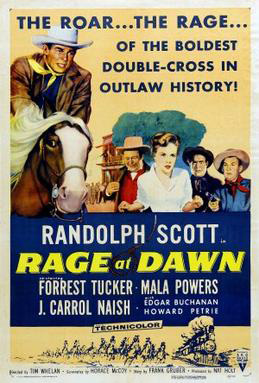
Rage at Dawn (1955)

Directed by Tim Whelan; produced by Nat Holt


In 1866 Indiana, the Reno brothers take advantage of the upheaval of the late Civil War to go on a crime spree, robbing banks and treasury offices with impunity, protected by corrupt officials in their town and county. Along with neighbouring law enforcement officials, a national detective agency has become involved, sending one of its top operators (Kenneth Tobey) to the scene, along with a new man, a former Confederate States intelligence agent (Randolph Scott). It doesn’t take long before their investigation turns violent.


Rage at Dawn is a bit of a departure for Randolph Scott, in several ways. Firstly, it is based on real people and events. Though highly fictionalised, this is a true story. The action is condensed and the time-line re-written drastically. Secondly, Scott does not appear for some while, the setting and situation being laid out before the viewer initially. Thirdly, its conclusion is not the normal one for a western.


Unfortunately, these novel elements don’t make for a superior film. Scott is as dependable a western star as John Wayne, and more likeable. He is, however, let down by the writing  and the production here.


The story is set in southern Indiana, an unusual location for a western (in this case, it may be termed a ‘mid-western’) but the movie was filmed in California (in an early scene, the latter’s flag may be viewed on a flag-pole in the background). Consequently, though the scenery is rather different than in many westerns - a more treed and less barren landscape - it does not look anything like southern Indiana. Most of the Renos met their fates before the end of the 1860s, yet the firearms used are those of the 1870s and ‘80s.


The story is adequate, but hardly delves deeply into the subject. For instance, who hired the ‘Peterson’ (read ‘Pinkerton’) Detective Agency to gather evidence against the Renos? The company would hardly have expended lives and money on their own account. Why were the Renos criminals? What made them turn to robbery and murder? Motivation in the film is light.


The action is decent, and the acting is good, especially among the minor players. But these aren’t enough to compensate for average writing and what must be termed lazy production. Scott is better served in the several movies he made with Budd Boetticher in the director’s chair, with Burt Kennedy writing the script. Check out one of these in preference to Rage at Dawn.

Monday, January 21, 2019

The File on Thelma Jordon (1950)

Directed by Robert Siodmak; produced by Hal B Wallis


An assistant district attorney (Wendell Corey), drunk and feeling sorry for himself because of his marital woes, meets a woman (Barbara Stanwyck) seeking help in protecting her aunt’s jewels. Despite an inauspicious beginning, the two hit it off and begin an affair. Risky at first, it doesn’t grow smoother when there is a robbery and murder.


There is a feeling to The File on Thelma Jordon that those involved were looking to make another Double Indeminity. The only connection among the cast and crew between the two films is the female lead, and though Stanwyck is usually enough to fill any cinematic requirement, there is no comparison. The File on Thelma Jordon doesn’t have the story, the suspense or the characters of the earlier movie. Nor does it have enough to be successful on its own merits.


As mentioned, one of the problems is the story. While the script is good, the plot itself doesn’t produce any surprises. What happens is pretty easy to guess, and, though the finale’s detail may differ from expectations, most viewers will arrive at the conclusion before the movie does. This is ironic considering the crime’s commission in Double Indemnity is explicit, but not shown here, yet the earlier film produces more suspense.


Another problem is the casting. Wendell Corey is meant to portray an ‘everyman’, caught up in intrigue and felony. But he is also meant to be someone whom two quite different women can’t live without. His performance does not convey that in the least. There is, in fact, nothing very appealing to his character; there is nothing repellent, either. He is a pretty mundane individual. Corey is very good at portraying the latter. This is no reflection upon his ability (check out his psychopathic murderer in 1956’s The Killer is Loose) but The File on Thelma Jordon demonstrates why he rarely appeared as a movie’s lead, and was usually cast in a supporting role.


Even Stanwyck does not make her character convincingly bewitching. The attraction between her and Corey and is not persuasive; at no point did I believe they were crazy in love with each other. I found Corey’s wife (Joan Tetzel) to be more alluring, physically and emotionally, than Stanwyck.


The File on Thelma Jordon was a missed opportunity, though it may have needed fundamental reconstruction before it became effective.

Tuesday, January 15, 2019

Drums in the Deep South (1951)

Directed by William Cameron Menzies; produced by Frank King and Maurice King


The beginning of the American Civil War divides two friends (James Craig, Guy Madison), the latter joining the Union army, the former the Confederate. It also ruins the chance Craig has to persuade a friend’s wife (Barbara Payton) - and previous love - to go away with him. Three years later, Craig is assigned the mission of slowing a Northern field army by occupying an impregnable mountain and bombarding the only available railway. Madison, by coincidence, is given the duty of dislodging the Confederates from the fastness.


Drums in the Deep South falls into the category of interesting but not really entertaining. (Yes, I surely couldn’t have created that category myself.) As a military historian, the accuracy in the film met with my approval. Firstly, the soldiers involved are principally from the arm of the artillery, which, though called the ‘king of battle’ is rather a Cinderella service in the films, behind the dashing cavalry and the more numerous infantry. The story-line follows the realistic attempts of the Northerners to beat the Southerners using various guns and means at their disposal. At one point, they resort to a frontal assault, which gunners would not have conducted - but in this case, the only troops available were those of the artillery. Items such as these appeal to me not only as an historian, but as someone who appreciates a writer who takes the trouble to know about his subject.


As a movie, though, Drums in the Deep South is not in the first grade. The acting, especially in the interpersonal drama of the initial quarter, is not expert; indeed, it strikes me as obvious and heavy-handed. It runs more smoothly once the action begins, but there is less of a demand by then upon the performers.


The direction, too, is obvious. A storm approaches at the film’s start, and breaks just as news of war reaches the characters. As well, there are loud rolls of thunder at the appropriate times when emotions run deep between the leads. It reminded me rather of the sort of skits Carol Burnett would do so well. The direction also doesn’t serve the story, in that, while the script is pretty pedestrian, it has its moments of excitement; these, however, are not utilized to full effect, probably because of the direction.


Drums in the Deep South’s potential was wasted, unfortunately, and what could have been a more rousing action film becomes an almost slight war movie.