Followers

Wednesday, August 25, 2021

Alias Nick Beal (1949)

Directed by John Farrow; produced by Endre Bohem


Joseph Foster (Thomas Mitchell) is a tough but honest district attorney who would do anything to put his city’s criminal bosses behind bars. He gets his chance when, after a casual remark about selling his soul to achieve his ends, he is contacted by a mysterious stranger named Nick Beal (Ray Milland). Beal is able to procure the evidence Foster needs against the crooks, but at the price of accepting it illegally. Foster’s victory propels him into state politics but each step he takes results in one more sacrifice of his morality, and at each step Beal is present to assuage Foster’s guilt. How far will the formerly upright man fall with his new ally’s help?


There is no puzzle as to who or what Nick Beal is, from the timing of his arrival to his name (‘Old Nick’ and ‘Nick Scratch’ have long referred to the Devil, while ‘Beal’ is a cleverly shortened BeĆ«lzebub). But the fun in this well-written movie isn’t the antagonist’s identity, but how it is interpreted.


Ray Milland may have won an Oscar for his work in The Lost Weekend (1945) but I don’t think I will watch one of his performances again in the same way, after seeing him in Alias Nick Beal. His is an excellent portrayal of a villain who is simultaneously smooth talking and threatening, helpful and malevolent. Insinuation and innuendo come naturally to the character, and his confidence is too great to make him smarmy. Such movies as this don’t receive much attention when it comes to awards - they are usually seen as too light (look at the history of comedies in the Academy Awards); even so, Milland’s less spectacular but more quietly effective work here could have convincingly been nominated for an Oscar.


Also overlooked - this time by film-history - is the engaging actress Audrey Totter, who plays a down-and-out woman scooped up by Beal to tempt Foster. Totter portrayed a number of femmes fatale in the film noir genre, looking somewhat like Gloria Grahame but with greater versatility.


The script is very good, with the characters, if not well-developed, then well-depicted. There are some very good lines, such as Beal remarking that he once met somebody - implied to be a heel - on the day he died. Few facts are made explicit about Beal, which is to the movie’s advantage, as his actions and words create the person the viewer knows him to be, though in an interesting, even entertaining incarnation.


The acts that transform Foster from the decent, crusading lawyer to the corrupt and discouraged politician are credible, each small act leading to a larger. This moral disintegration is paralleled by an intellectual degradation, the kind which leads Foster to denigrate his erstwhile allies as hypocrites, not for betraying their principles, but for denouncing his own betrayal. That’s a common trait among many once-great men.


The direction is also above par, especially in showing how Beal comes and goes, and sometimes merely appears.


The story has its flaws, most notably in its resolution, which is weak. It is not inconsistent, but perhaps less than the preceding story deserved. As well, the departure of one of the major characters is too abrupt.


Over all, however, thanks to the script and above all to the performances, especially of Milland’s, Alias Nick Beal is an excellent adaptation of the Faust legend, a good study of corruption and character.

Wednesday, August 18, 2021

Rio Conchos (1964)

Directed by Gordon Douglas; produced by David Weisbart


Two years after the American Civil War, former Confederate Army officer Lassiter (Richard Boone) lives only for killing Apaches, in revenge of their murder of his wife and child. Half-coerced and half-persuaded, he agrees to join a U.S. Army captain, Haven (Stuart Whitman), and his sergeant, Franklyn (Jim Brown), in tracking down a shipment of repeating-rifles that were stolen. After being joined by a flippant Mexican criminal (Tony Franciosa), the party follows a trail of Indian attacks intended to steal gold rather than kill, hoping to be led to a mysterious arms-dealer.


Rio Conchos, despite its late date, is rather a throw-back in many ways to earlier westerns, though it has elements of later films. It has plenty of action and some good gun-battles, with the violence seeming stronger than in many of its predecessors.


The direction is adequate – especially in the action sequences – while the acting is good. By this time, Boone could handle this sort of film without trying, and Franciosa probably had fun with his part. Whitman doesn’t really stretch himself and Brown, at the start of his acting career, isn’t given much to do.


The first half of Rio Conchos, however, is quite a bit superior to the second. This fact may have to do with the characters involved. Lassiter is a very bitter man, who nonetheless has not lost his sense of honour. His brief interaction with the colonel who recruits him shows that the two men respect each other, even if it is not stated.


Haven is an angry young man very much at odds with Lassiter, for reasons of his own. The Mexican, Rodriguez, appears a happy-go-lucky ne’er-do-well, who also has a separate agenda. These three play well off each other and their motives and goals keep the viewer guessing.


However, by the last reel, the dynamics have changed. The pointless death of one character and the loss of the others’ freedom reduce the entertainment of the story. The villain (Edmond O’Brien) has a scheme that seems both fantastical and vague, while the climax is strangely inconclusive in a number of ways.


Indeed, the difference in quality between the halves comes from the emphasis laid in the two parts. The first is about character, and relationships; the second switches to plot, which is not strong. Action overwhelms the individuals. This is not inevitable; in many other films, character and story go hand-in-hand. And perhaps they would have in Rio Conchos, too, if the script had been better.


The writer didn’t know, or didn’t care, that the U.S. Army was segregated in 1867; Franklyn appears to be a soldier among white comrades, whereas in reality, he would have served in a black regiment, with white officers. Adding to this historical incongruity, there are almost no references to Franklyn’s race. This would not normally bother me; there is no reason why race need be an issue – so long as the irrelevance isn’t out of place. Yet twice Franklyn is referred to as ‘the black’, in situations when a much more offensive word would likely have been used. It’s strange that in 1964 a film would have been so tame in this matter, when earlier pictures were more explicit.


While undemanding, Rio Conchos probably won’t satisfy the discriminating western fan, who may be left yearning for something more successfully crafted.

Wednesday, August 11, 2021

I Wouldn't Be In Your Shoes (1948)

Directed by William Nigh; produced by Walter M Mirisch


Young professional dance duo Tom and Ann Quinn (Don Castle, Elyse Knox) aren’t faring well. Gigs are few and far between: Ann is reduced to giving dance lessons and Tom isn’t working at all. They seemingly hit bottom one night when Tom throws what he doesn’t realise is his only pair of shoes out the apartment window at some noisy cats. Afterward, he can’t find them but they are anonymously returned the next morning. Worse is to come. The shoes are a clue in a murder, and the clue - and others - lead straight to Tom. Awaiting execution, the only hope he has is his wife and the lovesick detective (Regis Toomey) who agrees to help her.


The imaginatively named I Wouldn’t Be In Your Shoes is a production from Monogram Pictures, the most prominent of the addresses on Hollywood’s metaphoric ‘Poverty Row’ of low-budget studios. As in many cases, however, a low budget doesn’t mean a lack of entertainment. While let down by a script with more than the average number of plot-holes, I Wouldn’t Be In Your Shoes is salvaged by engaging performances and some decent scenes.


Castle and Knox, hardly well-known names, even among B movie fans (Knox had a short career, though her son, Mark Harmon, has had a rather longer one), do a good job in their roles as the luckless couple. Castle is especially natural. But it’s Toomey who has the best part, and makes the most of it. This character actor (a veteran of movies even in 1948, having started in film in 1929) has a substantial role, and, though a supporting player, is the most memorable in the cast. Everyone else delivers capable work.


The plot is derived from that gold-mine of film noir sources, Cornell Woolrich, though I suspect in its transfer to the big screen, it lost some of its cohesion. Much of the action will make a viewer wonder why something wasn’t done earlier, especially in the case of the police investigation, which features dedicated cops conducting an inquiry that children could do better. Their views of the evidence range from ‘water-tight’ in one conversation to ‘entirely circumstantial’ in the next. This, of course, is more the fault of the script than the story.


The production values are adequate, though pretty much what one would expect from the cheaper end of the Hollywood spectrum. At one point, for example, a scene is filmed in the interior of a candy shop. Through the open door we see, across the street, a stationery shop. Later, in the movie, we see the same stationer’s business, from the same angle, through the door of a grocery store.


But there are some sequences that redeem much. The interaction of several prisoners on death row (Quinn is referred to as ‘Five’) is surprisingly well-developed, given the amount of time devoted to it, and sympathetic. Another nice touch is a scene in which Ann, numbed by her husband’s imprisonment, is asked by a customer at the dance-studio how she is. When she asks if he really wants to know, he takes a look at her face and slowly answers, “No…” Such moments, lasting, in some instances, seconds, can uplift half a movie.


Though I Wouldn’t Be In Your Shoes shows plenty of evidence of either lazy or bad writing, and suffers somewhat from the small amount of funds devoted to its production, it gives a good indication why numerous films from studios like Monogram had a loyal following in the past and provide pleasant surprises today.

Thursday, August 5, 2021

King Solomon's Mines (1950)

Directed by Compton Bennett and Andrew Marton; produced by Sam Zimbalist


It’s 1897, and much of the interior of Africa is still unknown to Europeans. Jaded hunter Allan Quartermain (Stewart Granger) is hired by an Englishwoman (Deborah Kerr) and her brother (Richard Carlson) to find the former’s husband, who disappeared on a journey to find the fabled mines of the King of Israel. Quartermain believes the expedition’s chances of survival are nil, but agrees to lead it for a huge sum of money, providing his son with a decent future. Their adventures lead them to deserts and mountains, kings and cannibals, and not everyone who goes will return.


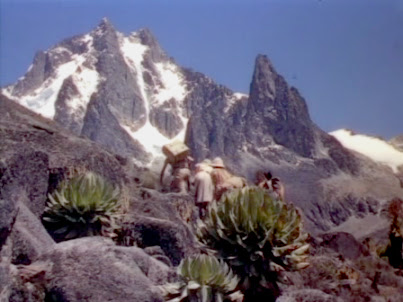
This is probably the best of the several film versions of Rider Haggard’s popular adventure novel. Though it departs from the original story in a variety of ways, it is exciting and interesting on its own merits. One of the attractions is its presentation not just of Africa, but of unknown Africa, as it might have been in the 1890s. Though a rudimentary map used by Quartermain’s party shows the ultimate destination to be somewhere in the modern Republic of the Congo, the film wisely uses the incomplete knowledge of the times. Thus, the party struggles through wastelands like Death Valley and over ridges as high as the Rockies.


The African villages through which they pass are not the generic type we see too often in lower-grade movies of the genre. Quartermain is based in a large town, the region’s metropolis, with its crowds, a market and a district headquarters, and eventually visits communities advanced and noble, primitive and decrepit, meeting people friendly, wary, hostile and indifferent.


The direction and writing are good, as well. Several scenes are outstanding, such as the stampede, which must have been a bit nerve-wracking to film, never mind for the characters to endure, and a sequence in which Quartermain and a village chieftain bargain for the use of the latter’s boats, arguing and shouting as if at a political debate, with all settled amicably afterward.


The use of scenery is well-handled, complimenting the changes in native lifestyle and habitation, an indication of new and contrasting countries.


Only three characters are developed to any extent, and of these, Quartermain’s is the most interesting. It’s surprising how well, even in this 1950 incarnation, he could fit into the twenty-first century; it would not be difficult to see him at the forefront of environmentalism.


Though he made his reputation in fifteen years as a hunter, by the start of the film, he is guiding amateur hunters in their coddled quests for big-game trophies, and he’s thoroughly sick of it. He states that he sometimes prefers animals to humans (one gathers that ‘almost always’ would be the more accurate words) and doesn’t shoot them anymore except in self-defence.


Interestingly, while many stories of Europeans or North Americans in the Third World have the environment uplifting the individual, Quartermain has, he believes, learned from the continent the pointlessness of life, yet he still sees how, within that pointlessness, everyone can achieve much of what they want. When his personality is considered as a whole, it is surprisingly complex.


With its successful treatment of its setting’s mystery, its various situations and intelligent script (by Helen Deutsch, who also wrote the screenplay for the excellent Kim, produced the same year), King Solomon’s Mines will satisfy most viewers’ needs for a fun yet thoughtful adventure.


Thursday, July 29, 2021

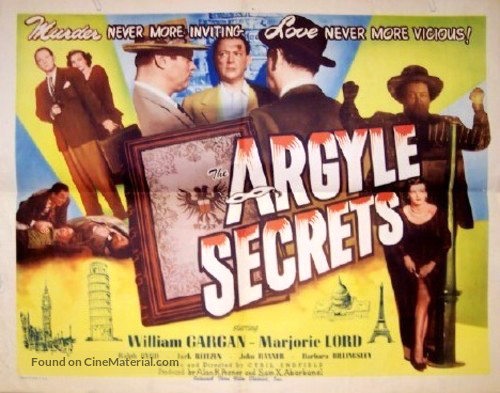
The Argyle Secrets (1948)

Directed by Cy Endfield; produced by Sam X Abarbanel and Alan H Posner


Reporter Harry Mitchell (William Gargan) is sent to the hospital bed of colleague Allen Pierce (George Anderson) to find out what he knows about a mysterious book, the Argyle Album. Mitchell doesn’t get the chance to learn much, as, during his visit, Pierce dies, seemingly from a scalpel wound. The questions raised by the death, and by the Argyle Album, send Mitchell on a deadly search for gangsters, extortionists and traitors.


The Argyle Secrets is in many ways a typical B-movie from the Golden Age of Hollywood, and B-movies, in turn, are rather akin to the independent feature of today. Varying widely in quality, they have low budgets and largely unknown casts. One of the differences between yesterday’s B-movies and today’s independents is that the former’s plots were normally unimaginative and derivative. This characterises The Argyle Secrets.


William Gargan was a good actor – nominated for an Academy Award in another movie – who does what he can here. He is suitably tough and intelligent, conveying the impression of a man determined to be courageous, even when he doesn’t want to be. (Though his credibility may have been hurt in my personal estimation by resembling too much Sidney James, of the Carry On… series of farces.)


The other actors are capable, but no more so. Marjorie Lord is convincing as the obligatory femme fatale. The most recognizable minor player is, perhaps, Barbara Billingsley, later to portray June Cleaver in tv’s Leave It to Beaver, though Hogan’s Heroes’s John Banner portrays a villain.


The characters in the cast are interesting to different degrees, and are the best aspect of the film. They are not developed enough, however, and appear a bit too self-consciously based on other movies’ characters, especially Jack Reitzen as a Sydney Greenstreet-type personality. And one named Winter has a Mittel-European accent that is at odds with his attempt to hide his Nazi connections.


The story is a fairly standard one of the protagonist searching for an object, with the police on the trail of both the object and the protagonist, while villains of various shades try to outwit or kill both parties. Alfred Hitchcock popularised the term ‘MacGuffin’ for such  objects in such films; it didn’t matter what it was, so long as it provided an excuse for mystery and action. Probably the most famous movie MacGuffin is the title statue in The Maltese Falcon.


In The Argyle Secrets, the object of everyone’s desire is a book containing the names of American Nazi-collaborators. Mitchell doesn’t know at first why it is important, and his rivals have several reasons for wanting it. The album in question illustrates some of the lackluster interest the writer seemed to have had in the actual story. The album’s name suggests a Scottish origin; the double-headed eagle on its cover implies Imperial Russian or Austro-Hungarian connections; yet it involves Germans and Americans.


The story is both lazy and shoddy. Mitchell learns of the album’s secrets too soon and too easily. Instead of uncovering them, he is simply told of them. The book’s pages contain numerous names, but only two other parties are searching for it. Why two? One is mentioned in the book and so wants to avoid condemnation for his past crimes; the other is intent on using the book for blackmail. The choice of villains and motives seems arbitrary.


Pierce, who brings the secrets to Mitchell’s attention, is murdered, and his murderers spend the movie seeking what the man they killed could possibly have been tricked or coerced into revealing. And, though Gargan effectively portrays Mitchell as a clever man who pieces together the puzzle over time, the conclusions to which he comes are not really supported by the clues given.


The Argyle Secrets is an adequate time-filler, though there are numerous other B-movies that do better with the same or less. What I thought of most after the film was over was that its director (who also wrote the screenplay) was also behind the camera for the 1964 war-blockbuster Zulu!

Thursday, July 22, 2021

The Artist (2011)

Directed by Michel Hazanavicius; produced by Thomas Langmann


At the top of his profession, silent-film star George Valentin (Jean Dujardin) loves his work. He enjoys making movies, he enjoys the adulation, he enjoys his life. But as the 1920s draw to a close, two things arrive to disrupt that most satisfactory existence: bright and ambitious young actress Peppy Miller (BƩrƩnice Bejo), and talkies.


There isn’t much wrong with this superb motion picture. It is a (mostly) silent film about the coming of sound to Hollywood. It may be seen as a companion-piece to Singin’ in the Rain: an examination of the time period from the other side. While both films might be considered light-hearted, they are also heart-felt. Despite being filmed in black-and-white and almost without sound (except for music), it is not a satire of silent-films, but a valentine to them, a demonstration of just how well they worked.


The plot is a melodrama straight out of the Silent Era, though its likes have been carried forward to the present day, even to the third remake of A Star is Born. Superficially (both in appearance and career-progression), Valentin resembles real-life actor John Gilbert, while his movies are more reminiscent of Douglas Fairbanks’s. That The Artist is a melodrama should be seen as in no way a detriment, as the story is sincere and well-crafted.


There are, throughout the movie, parallel but closely connected storylines, Valentin’s career crumbling and Miller’s building. Yet alongside these events, the two characters maintain an interest in each other, supporting each other if only from afar.


The actors are excellent. The two leads have a winning chemistry, perhaps formed in an earlier film – OSS 117: Cairo, Nest of Spies – also directed by Hazanavicius. Both players have an almost immediate charm, which allows you to like their characters and support them, without being blind to their flaws. The players must, necessarily, be able to act with the slightest of expressions, and this they do, Dujardin especially. There is a brilliant little sequence when performance and direction combine to open a window into Peppy’s mind and heart as Bejo acts opposite a tail-coat.


The leads are backed up by a number of fine if subdued performances. John Goodman plays the head of the fictional Kinograph Motion Pictures (a man who would probably like to be a ruthless cinema mogul but isn’t enough of a jerk); Penelope Ann Miller has a thankless role as Valentin’s wife; James Cromwell is his devoted chauffeur; Ed Lauter as a butler, and Malcolm McDowell in a tiny (dare I say it?) non-speaking part as an extra awaiting an audition. And I can’t forget Uggy, as Valentin’s beloved dog.


While the likeability of the stars influences their characters, they, in turn, influence the audience. Valentin undoubtedly has an ego – he has a life-size portrait of himself (with his dog) in the hall of his house – but he is also cheerful and friendly, with a nice word and a joke even for the stage-hands at the studio, and despite temptations, he remains faithful to his wife, though their marriage is moribund.


Also, Valentin’s love for his craft is apparent (hence the movie’s title). At the premiere of his latest film, he is shown watching the movie from behind the screen: on his face is the quiet happiness felt by everyone who has accomplished something both enjoyable and good.


Whether intended or not, Valentin and Peppy Miller are very similar. Miller’s rise in Hollywood during Valentin’s descent feeds both her ego and clear desire for attention, yet she is quick to regret any slight she might inadvertently make.


And lastly, the direction, which is faultless. Whether Hazanavicius (who also wrote the screenplay) could pull off another such complete and involving movie I cannot determine, but his touch here is deft. The manner of direction is a studied tribute to that of the Silent Era. Like films from that time, dialogue cards are used but, again like the Silent Era, they are not, in fact, necessary. As Norma Desmond says in Sunset Boulevard, “We didn’t need dialogue. We had faces.” There are scenes in which Peppy watches Valentin from a distance (and thus effectively without sound), yet is overcome by emotion; another tribute to what made silent movies work.


The Artist can be treated as a movie made just after the advent of sound, looking back at recent events. Sound is utilized but only at imaginative and strategic moments, particularly at the end, when it reveals something about Valentin that might – or might not – have influenced his attitude toward talkies.


The Artist will remain one of my favourite movies, and, if it doesn’t ignite viewers’ interest in silent-films, will surely make them want to see this one again.