Followers

Sunday, May 10, 2020

The Reckless Moment (1949)


Directed by Max Opuls; produced by Walter Wanger


Lucia Harper (Joan Bennett) is a middle-aged housewife with a full life caring for her family while her husband is building a bridge overseas. Trouble arises when her daughter, Bea (Geraldine Brooks), becomes involved with ne’er-do-well Tom Darby (Shepperd Strudwick). Lucia attempts to buy off the cad, but he soon visits Bea surreptitiously. The two argue and fight, Bea striking Darby with a flashlight. In the aftermath and left alone, the stunned man stumbles and dies in the fall. The next morning, Lucia discovers the corpse and hides it. Her problem is just beginning, however: a blackmailer (James Mason) arrives with letters Bea had written, and which would implicate her in what the police are treating as a murder.


The Reckless Moment has many of the elements of a successful suspense film – except suspense. This, I think, is the fault principally of the script, but aided by the direction.


The director is better known as Max Ophüls, who has a distinguished reputation, especially in technical expertise. I noted several scenes that were very interesting to watch; in particular, in the snatches of conversation and background images that could be observed, actually irrelevant to the story. But there was little tension or drama, as opposed to melodrama, evident.


The script is mundane. The initial scene with the bounder whose death instigates the blackmail is meant to show that he is open to being bought off by his girlfriend’s mother, but it merely suggests it, and could be seen as the man simply trying to understand how far the woman will go to disrupt his romance. When Darby is with Bea, prior to their fight, he intimates that, while he does need her mother’s money, they could take it and still be together. Though his character is later implied to be base, the audience is not shown enough for them to believe he received his just desserts. (And can he really be so well-known as to have his name given in a newspaper's headline when he is killed?)


On the other hand, Bea, a seventeen year old who thinks she’s far too wise for her mother, smartens up abruptly – too abruptly – during her argument with Darby. Lucia is not made sympathetic enough. This may be the coldness of Bennett’s performance, but is likely a problem with the script, too. Along with suspense being missed, so is a principal character we care about.


Mason does a good job as the reluctant blackmailer – he’s the one who comes across as sympathetic, even noble – but his decision to help Lucia any way he can comes too swiftly, and, after an alleged lifetime of bad deeds, seems too cinematic a change to be realistic.


Later tv stalwart William Schallert appears unbilled as a police detective, and a super-star of the silent-film era, Dorothy Phillips, appears in a tiny part, though I couldn’t tell anyone which.


The Reckless Moment is hampered not by a bad plot or indifferent acting, but by unconcentrated writing, and direction that doesn’t create the right atmosphere or a depth of tension. For a movie founded upon a similar theme but with sympathetic characters, a more intelligent script and a good plot twist or two, see Mr. Denning Drives North, and skip over The Reckless Moment.

Sunday, May 3, 2020

The Desperate Hours (1955)

Directed and produced by William Wyler


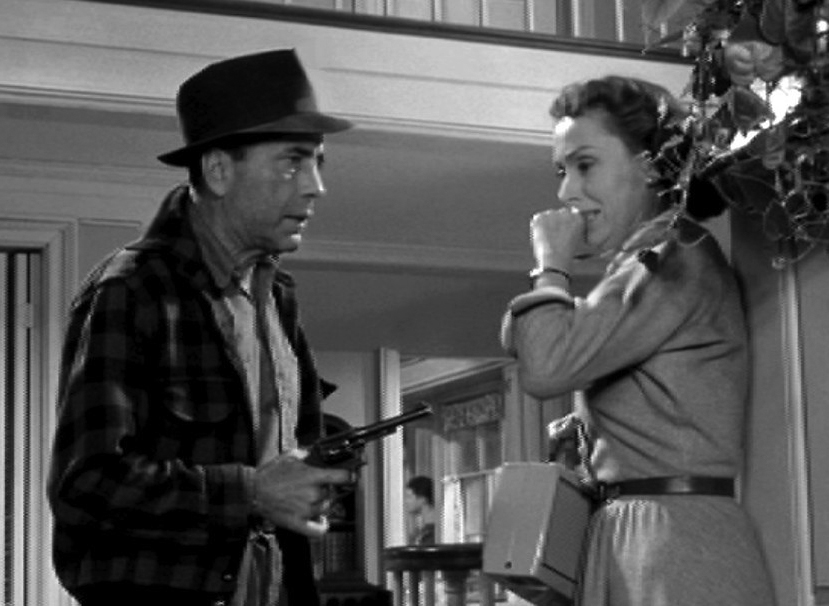
After escaping from prison, a violent criminal (Humphrey Bogart), his brother (Dewey Martin) and an accomplice (Robert Middleton) hide in a quiet, suburban house. The head of the household (Fredric March) is told that the convicts will be gone at midnight, when the leader’s girlfriend arrives but, fearing for his family, he knows much can happen in the interval.


A tense and involving film from start to finish, The Desperate Hours was Bogart’s penultimate movie, and one of his best. Superficially, it has a similarity, in setting and in Bogart’s character, with The Petrified Forest, which made him a star nineteen years earlier. In both cases, innocent people are taken hostage by crooks on the run, who must wait for a woman to arrive. But, while Duke Mantee, whom Bogart portrayed in the first film, is more of a catalyst than a character, Glenn Griffin, whom he plays in The Desperate Hours, is fully a part of the drama.
  

The movie depends upon the two leads. Bogart injects menace into the story from his first scene. Indeed, the movie would have failed if he had not, and demonstrates how good an actor Bogart was. His mannerisms, expressions and tone of voice are familiar; he used them in almost every role. Yet Griffin is cruel and vicious, even sadistic; beyond Mantee (viewers won’t be persuaded that Griffin cares more about the woman he’s waiting for than the money she’s bringing him), miles away from Philip Marlowe (The Big Sleep) and the opposite of Rick Blaine (Casablanca). How Bogart manages to create such a frightening creature with tools so little different than those utilized to make likeable rogues and even heroes must be attributed partly to talent and partly to sheer presence. Bogart was a true movie star.


Equal to Bogart, though in a necessarily more subdued part is March. Initially, we see him as a contented, even happy family man, whose biggest problems are that his little son (Richard Eyer) wants to be called ‘Ralph’ instead of ‘Ralphie’, and that his daughter (Mary Murphy) may be serious about her new boyfriend (Gig Young). But as the situation worsens and the strain builds, March convincingly portrays hope, intelligence, fear, panic and rage, all of which must be kept contained, until the very end. March must show many of these emotions almost invisibly, so as to keep the villains from understanding his thoughts. Even so, Griffin reads his hostage well.


The other actors are uniformly good. Martha Scott as the wife and mother behaves as most would, trying to maintain composure in the face of immense pressure; Arthur Kennedy, as the police officer familiar with Griffin, starts off with seemingly selfish reasons for wanting to stop the criminals, but becomes March’s best ally outside the house. A very young Beverly Garland plays a school-teacher and comic actor Joe Flynn a terrified motorist.


The interaction between Bogart and March forms much of The Desperate Hours, but the former’s scenes with Martin, as the younger brother, also have great interest. We see the elder Griffin as someone who loves his sibling, but in a bullying, denigrating manner, disguised as teaching the boy how to live in a harsh world. The young man’s brief glimpse of kids his age heading off to a party speaks volumes about lost opportunities and wasted lives.


The script is excellent, as might be expected in a movie from a Tony Award-winning play, and intellligent. The direction is as good, turning what could have been simply a filmed stage-work into a real movie, and a bit of an action picture at that. However, the tension that is created, the suspense that keeps the viewer watching, comes from words and emotions, rather than deeds, and that is greatly to the director’s credit.


Despite the shoot-outs, the beatings and the outdoor scenes, The Desperate Hours is about character – and characters: how they conflict and how they coöperate. Though the writing and direction cannot be faulted, it is a showcase for actors, in particular the two veterans: March and Bogart, the latter surely already feeling the effects of the cancer that would kill him soon afterward.

Sunday, April 26, 2020

The Duellists (1977)


Directed by Ridley Scott; produced by David Puttnam


Armand d’Hubert (Keith Carradine), a young staff officer in Napoleon’s army, has the unenviable task of summoning a fellow officer, Gabriel Feraud (Harvey Keitel), to a disciplinary interview with their general. Feraud, angered at what he perceives to be the injustice of the message, conceives an immediate dislike for the messenger and, despite the subject of his summons being the duel he fought that morning, challenges d’Hubert there and then to another duel. Thus begins a sixteen-year saga of obsession and combat, as Feraud and d’Hubert fight a battle whenever they meet. Only the death of one gentleman – or of both – will end their ordeal.


Those who know director Scott from his science fiction works (eg. Alien, Blade Runner) or his action flicks (eg. Black Hawk Down) might be surprised that his first feature film was this historical drama, a small epic, based on a Joseph Conrad story. That story was itself based, remarkably, on truth: the twenty year running duel between two French Army officers. And while Scott went on to direct excellent movies, including others with historical subjects (eg. Kingdom of Heaven), The Duellists must remain one of his best.


The first thing one notices is the film’s beauty. Undoubtedly, Scott and his cinematographer, Frank Tidy, were inspired by the paintings of the late classical era. Outside scenes resemble landscapes, interior shots still-lifes and portraits. The colours are rich and the textures are almost palpable. The lighting is that of a worker in oils as much as a director of celluloid.


The illusion of time and place is aided immeasurably by the detail. The costumes, especially, are exacting and realistic, to which close-ups will testify. The sets are also true to life; they should be: to limit his budget Scott used existing structures.


The casting might seem very odd. Two American actors, Keitel particularly familiar as rough, urban men, could at first come across as misplaced. This is not borne out by their performances. The Al Pacino film Looking for Richard demonstrated to me for the first time, even though it was a documentary, that Americans could effectively portray Shakespearean characters, even using their every-day accents. The Duellists does the same for Americans playing Europeans of a couple of centuries ago. Ability and a good script will do much in the way of credibility. In this case, they are assisted by the fact that the French revolutionary army, and its successor, Napoleon’s army, were filled with officers, indeed, generals, whose humble origins would have kept them privates or corporals in the old royalist army.

Backing up the leads are a host of excellent actors, mainly in small roles (Robert Stephens, Tom Conti, Albert Finney, Edward Fox, Pete Postlethwaite (in his first role, a non-speaking bit as a valet shaving Stephens) and Stacy Keach as the narrator).


The characters are, perhaps, the weakest element of the movie. Of Keitel’s, we learn almost nothing, though that in itself may tell us something. We see him living for his duels; one of the few times we view him doing something else, it is arm-wrestling, and even here, he demands a re-match when he loses to a comrade. There are moments of note, however, as when Feraud, at a low point in his fortunes, watches, as if for no reason, a dog tied to the back of a cart, forced to trot along to someone else’s commands. Carradine’s d’Hubert is more rounded: he is, really, an introvert, content with a few friends, astounded, and appalled, by his growing fame as a ‘man of reputation’, a ‘fire-eater’, a fearsome duelist. A conscientious officer, he is just as happy in peaceful domesticity.


The direction, aside from the settings and backgrounds, is spot-on. Interspersed with calm, almost still moments – a dinner in a tavern, a couple speaking quietly of home matters – are the duels, some precise and quick, others brutal and exhausting.


As an historian – one who is constantly complaining of inaccuracy in films – I found nothing about which to complain in The Duellists. The writer paid attention to military processes and habits. The weapons and uniforms in particular are given attention: d’Hubert and Feraud are both officers of hussars (a type of light cavalry) but, belonging to different regiments, their garments are similar with differences. These change through the years, the tall shako, for instance, giving way to the taller fur busby. The passing time is shown, in fact, more by fashion than by anything else, as we watch the action span the years of Napoleon’s rule, taking the characters from rural France to frozen Russia. There is no concession to modern sensibilities in The Duellists (it was made in 1977, after all): people here act as they would have in the early nineteenth century.


Whether one watches The Duellists for its history, its action, its beauty or its breadth of romance (in the wider, original meaning of the word), this movie will satisfy most. It is one of the best works from one of the best directors.

Monday, April 20, 2020

Canyon Passage (1946)

Directed by Jacques Tourneur; produced by Walter Wanger


In 1856 Oregon, ambitious entrepreneur Logan Stuart (Dana Andrews) will take any risk for his fledgling transport company. He will also take any risk for a friend, even one like George Camrose (Brian Donlevy), whose business in a mining community is crumbling, just as he is about to marry the beautiful Lucy Overmire (Susan Hayward), who finds Stuart more appealing than her fiance. Add to this a murderous rival (Ward Bond), an incipient Indian war, and a girlfriend (Patricia Roc) with different ideas of their future, and Stuart will be having a busy time…


This early Universal colour western (or ‘northwestern’) has much going for it. The leads are highly watchable, the story has enough threads to weave a saddle-blanket and the action ranges from fist-fights, to shoot-outs, to massacres. The story is a good one, and the script is well-written (adapted from that prolific origin of movie plots, The Saturday Evening Post).

In particular, the characters are well-defined. While Andrews’s role has him as a tough, determined and invincibly loyal friend (even to his own detriment), it is Donlevy’s character that stands out. Camrose is basically a self-destructive man, his otherwise thriving commerce threatened by his incessant gambling, and his romance rocky due in part to his fascination with an acquaintance’s wife (coolly played by Rose Hobart). Yet he is not an unlikeable man, even when driven to homicide. His questioning of another man’s idea of friendship shows that he appreciates its value, and the resignation he feels over his faults is very human.


The other characters are also well-written, too, as is their ambivalence to the local Indians, one settler (Andy Devine), seeing nothing wrong with their dispute with homesteaders, acknowledging that the land is the Indians’, after all, but also being indignant that the Indians resent the settlers.


An interesting aspect of the writing, not entirely satisfactory, is the slightly inconclusive ending. This seems a match for the number of characters who are killed off-screen. Both elements are, of course, realistic: not everything in life ends neatly, and on the frontier, deaths were sometimes known only second- or third-hand. Even so, there is a touch of incompletion to Canyon Passage because of it, however intentional it was on the writers’ part.


The photography is excellent and the direction rightly takes advantage of the then-new colour technology. The location shooting is utilized well. There is tension in a number of scenes, including a kangaroo court’s trial, that shows how precarious life could be on the frontier, even amongst people one thinks of as friends. Stuart’s reaction to a crowd’s enjoyment of his brawl with a rival approaches the contempt that rival has for it, making the viewer see that even in great contrasts, there may be comparisons.


At 92 minutes, Canyon Passage is not a long movie, but it nonetheless conveys a convincing impression of time and distance in the wide spaces of a largely wild land. A miniature epic, it is a western with a different setting, a setting which serves it well and which is, in turn, served well by the movie’s other components. (But no one passes through a canyon - just the opposite, as characters must crest a mountain range in their journeys…)

Monday, April 13, 2020

The Crimson Kimono (1959)

Directed and produced by Samuel Fuller


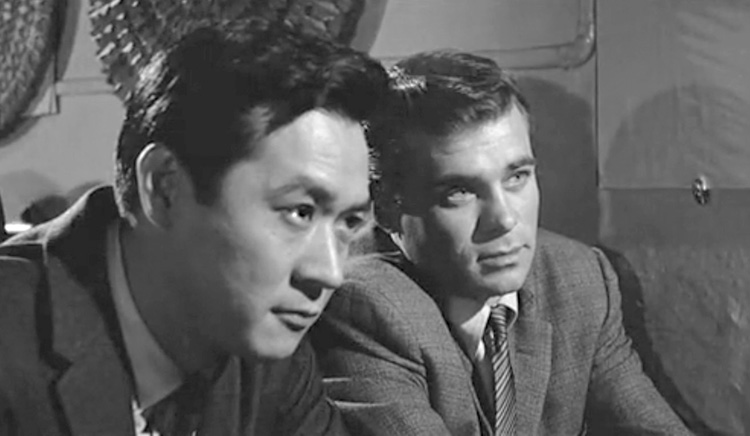
A stripper (Gloria Pall) is chased from her dressing room and shot to death on a busy Los Angeles street. The detectives (Glenn Corbett, James Shigeta) assigned to the case find a few leads, but when one of them involves a young artist (Victora Shaw), the investigators’ partnership and friendship are endangered.


An intriguing movie, The Crimson Kimono is actually an examination of race-relations and personality, rather than a crime story, and in that regard may disappoint some viewers. The tale, written by director Fuller, is a good one, if not very good; the mystery of who murdered the woman, and why, is merely a frame for what Fuller clearly considers the more important element of the film. There are no real clues, and everything is pretty much solved when the main suspect is found.


The script is interesting for the angle that is taken: considering the hard edge of Fuller’s other condemnations of racism, the only person in the movie who comes across as racist is Shigeta. Perhaps the lack of animosity toward Japanese-Americans on the part of other characters was meant to accentuate Shigeta’s feelings on the matter.


The actors are good, for the most part. Fuller was what would now probably be called an independent film-maker, so he often cast unknowns. The Crimson Kimono was the first feature film for both the leads, while Shaw had had a few roles prior to it, which accounts for her billing above Corbett and Shigeta, who have more screen-time. Screen veteran Anna Lee has a good role as a semi-alcoholic painter and society-informant.


There are no stereotypes in the movie, and everyone comes across as an individual. Corbett is as good a practitioner at kendo (Japanese sword-play) as is Shigeta, and one of the latter’s friends, clearly a Japanese-American raised in the United States, remarks of a Korean immigrant that his Japanese is ‘as bad as mine’. The Japanese-Americans depicted take their American-ness for granted, but have a pride in and respect for, their ancestry.


Much of the interest may be derived from the setting in Little Tokyo, the Japanese district of Los Angeles. Fuller uses locations well, and knows how to film them.


As a character study, then, as a story about relationships, The Crimson Kimono is involving and entertaining. As a crime flick or film noir, it quickly stalls. Whether a viewer values the time he invests in it will depend on what aspect of the film he wants to see.

Monday, April 6, 2020

The Big Steal (1949)

Directed by Don Siegel; produced Jack J Gross


A U.S. Army officer (Robert Mitchum) is a fugitive in Mexico, chasing down the robber (Patric Knowles) who stole his payroll. The officer, however, is being blamed for the theft himself and is, in turn, being pursued by his superior (William Bendix). Tied up in the farrago is the real criminal’s fiancée (Jane Greer), while watching it all with great interest is the canny local police chief (Ramon Novarro).


A light-hearted caper film with romance and fisticuffs, The Big Steal has a couple of highly capable actors in the lead roles, a famous director near the beginning of his career, and benefits greatly from location filming. Otherwise, however, it is a rather lacklustre effort.


As good as Mitchum and Greer are, they don’t have chemistry together. They act their parts very well, but I never thought their characters would have more than a passing attraction for one another. Former silent-movie heart-throb Novarro is entertaining as the police inspector-general who is learning English; he has much less to learn when it comes to catching crooks. Bendix is effectively menacing as the beefy army captain on Mitchum’s trail.


The story is rather bland and straightforward; though there is a twist in the climax, it will likely come as little surprise to viewers. The script tries hard for repartée between Greer and Mitchum, but they were never destined to be a new William Powell and Myrna Loy. Their dialogue is, for the most part, what anyone could come up with in similar circumstances. The dichotomy of including violence with comedy is not jarring but is, at times, unrealistic. Bendix is willing to shoot at a moving car containing what he must think is an innocent woman, but when a flock of sheep bars his path, instead of driving through them, he is stymied. He didn’t strike me as that sort.


The direction is good but not outstanding; a motor chase is handled well, but, for the most part, Siegel’s better days were yet to come. An interesting sidelight is the depiction of Americans and their behaviour in Mexico: they are mainly impatient and annoyed at the natives, for their tardiness, their legality and their language. Though there are a couple of Mexicans implied to be thieves, the people of the country come across as much the more likeable nationality.


While The Big Steal may be an adequate time-filler, there are better caper films, funnier comic adventure flicks, and more involving light-romance pictures. I’d track down some of them in preference.